Ray Johnson Show a Multiple Power Play
“to make open the eyes” Josef Albers All work of Ray Johnson on this site is used by permission of The Ray Johnson Estate
BMC to NYC: The Tutelary Years of Ray Johnson (1943-1967)
Ray Johnson was probably the most enigmatic and least appreciated artist of his importance in the 20th century. He was a man of many many layers, not so much depth, on first impression, just layers, fairly random factors that underlie and overlay his work. The show just ended at The Black Mountain College Museum and Art Center had many layers itself, over multiple valuable events, and provided a greatly needed showcase and explication for this “seminal figure of Pop Art” whose collages “influenced a generation of contemporary artists.”

The show and especially its catalogue were already reviewed here, but several subsequent events have enriched the impact of the show. Dr. Francis F. L. Beatty (quoted and seen above), a curator who works with the Ray Johnson Estate, gave a lecture at the BMCM+AC on May 21, using parallel slides to show that Ray displays elements in his collages that link him to the major artistic trends of the day. His wit, humor and intense communications of all kinds were highly stimulating but hard to classify, but his collages and the palette he created out of found and encountered material can be seen as fully in the tradition of Klee’ as well as Albers, while partaking of the humor of Dada. “I don’t make pop art. I make chop art.” Ray’s statement refers to his use of old work in new, and Dr. Beatty skillfully elucidated the way in which Ray’s “chop art” (often meticulous geometric constructions) came right out of his Black Mountain experience. She makes a point that reverberated through this show: the liberation of American education happening at Black Mountain served as well to “liberate Ray Johnson.” He found himself, and he found the principle that best illuminates the breadth of his work for me: images standing in for words, words become imagery.
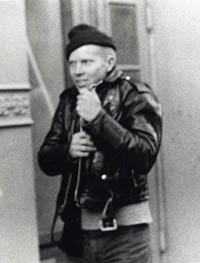
ray_johnson by Rose Hartman via John Wilcock
Yet Ray remains enigmatic. Dr. Beatty spent much time on the 55 Moticos – huge intricate collages – which Ray made and destroyed, calling them “some of the earliest and most significant examples of Pop Art.” She recounted many personal interactions with Ray, such as the time he approached her and finally wanted to do a gallery display – of “Nothings.” Beyond his inscrutability, his avoidance of the commercial process, Dr. Beatty makes a simple but important point – the small scale of Ray’s visual work limited his gallery prospects and indirectly his artistic stature.
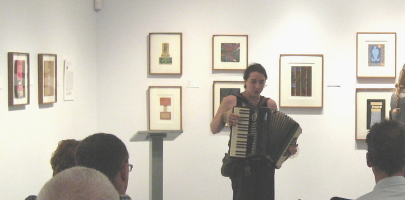
- Asheville Vaudeville performer closes Ray’s show
The scale of Ray’s imagination and willingness to live his life for art was unbounded, of course. The final night of the show, orchestrated by curator Sebastian Matthews, was a truly wild and wonderful event that did much to reflect Ray’s spirit. Music, poetry, and spoken word all filled the space.
“We have to seize the things we need to create.” These words were spoken in Picasso’s voice by Keith Flynt, one of the closing night performers (seen below).
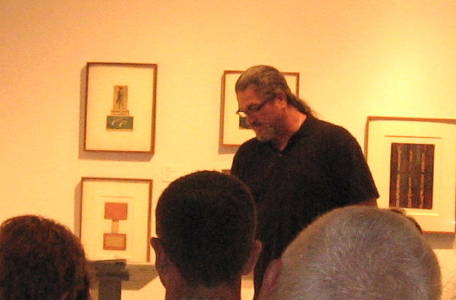
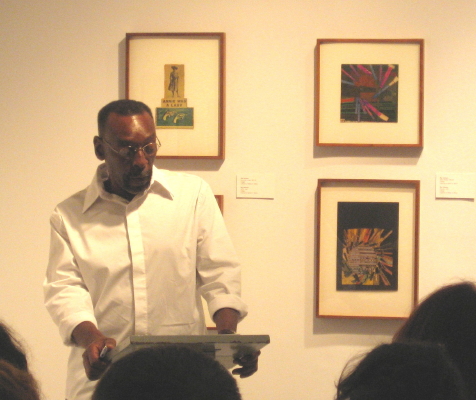
Earl Bragg, seen above, offered a nine-eleven poem that featured number names – worthy of Ray’s glyphs and puns. His political themes and passionate phrases made for an excellent reading.
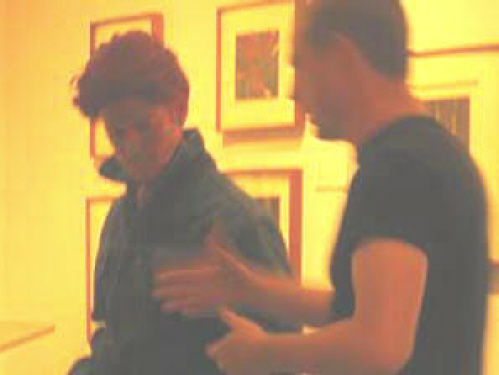
Local dramatists staged a reading of a collaged piece incorporating Ray’s play inside a play about Ray discussing a play with pink James Dean.
The final word has to go to Sebastian Matthews, who did such a magnificent job not only of putting on the show but of staying in touch with Ray’s spirit the whole time. He evoked and nurtured the image of Ray as filled with humor, energy – and a total lack of any sense of propriety. About the “chop art” and “lost art” which was so prominent in the show, he says: “Ray loved to make things up, kill them off, and resurrect them.”
The Ray show is dead, long live the Ray show.
Ray Johnson: Tracking Deep Currents
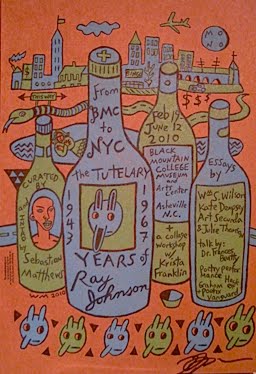
The Ray Johnson show at the Black Mountain College Museum in Asheville opened February 19th and will run through June 12, 2010. The opening was spectacular, the show is rich, varied and informative. For Ray J fans like me, the catalogue and it’s essays, assembled by show curator Sebastian Matthews, is the real treasure. Sebastian spent over a year studying Ray’s life and work, making connections with important people in Ray’s life (Ray passed in an act of suicide in 1995), and establishing his own perspective on the evolution of Ray’s art from a young art student in Detroit through a strong experience at Black Mountain College to an important role in the art scene of East Village in the 60’s and 70’s. The show displays extensive early work, including fairly typical ink doodles of 14 year old Ray, but also hilarious cards and visual puns from this period that presage his later work.
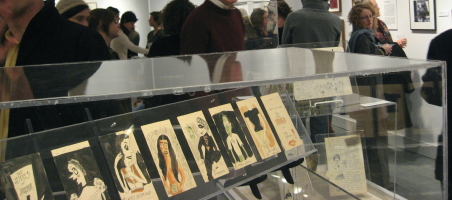
The show also reveals the aspect of Ray’s work I most needed to learn myself – that Ray came of age as an artist in the painterly traditions BMC and Josef Albers provided, and did lots of wonderful work as he evolved from painting to collage and then on to the correspondence work or “postal performances,” as Isa Bloom calls them, which made him most famous. The show focuses on Ray’s emergence out of Black Mountain College into the New York scene immersed in the ideas of his BMC mentors but prepared to follow Alber’s dictum: “to follow me, follow yourself.” As Sebastian Matthews says in his catalogue essay, “Ray was ripe for the challenges and experiences Manhattan had to offer.” He became one of the most intriguing and complex artists of the 20th century, and this show delineates many of the roots and threads that set him on his path.
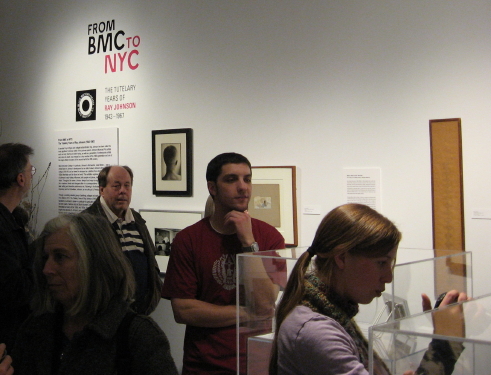
The opening of the show was well attended and featured some aspects Ray might have liked very much, though he generally was quite ambivalent about exhibiting or selling or even saving his work. Poetix Vanguard offered spoken word performances during the event, and an open mike followed at a bar nearby. The BMCM+AC library, with many Ray J items prominent, provided a nice context for the highly varied show. Several of Hazel Larsen Archer’s gorgeous photos of Ray at BMC were on display. And Sebastian Matthews, collage artist himself and so clearly a Really Great Guy, presided with enthusiasm over the many energies he had gathered to celebrate the amazing career of Ray Johnson.
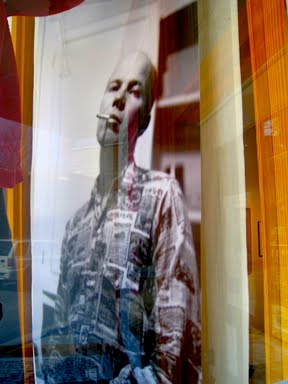
Ray J show window display at BMCM+AC
The catalogue contains 46 color plates, over a dozen images in the text, and several of Archer’s photographs. It also contains an interactive feature: a pair of postcards bound in as endpapers which the reader is invited to alter as desired and send off: one to a friend and one back to The Black Mountain Museum and Arts Center, whose program director Alice Sebrell is credited by Sebastian as being integral and vital to the process of creating the show. Five essays offer views of Ray that are remarkably varied and complementary.
Sebastian Matthews presents his curatorial essay as nine journal notes written while building the show. He elaborates his basic point: that Ray Johnson “used Black Mountain College as a springboard to propell himself into the Manhattan art world.” He also does a remarkable job, with his intense self-examinations, numerous concrete biographical insights, and constant awareness of Ray’s own probable intent to be inscrutable, of helping us have a “fuller sense of what Ray attempts when he sits down to make art, when he prepares to send out the work to be received, passed on, altered.” The quote is what Sebastian hopes to accomplish with the show, and I think he got there. He also truly transformed my personal sense of Ray J by portraying the intense, painterly, quite technical control Ray exerted over his collage work.
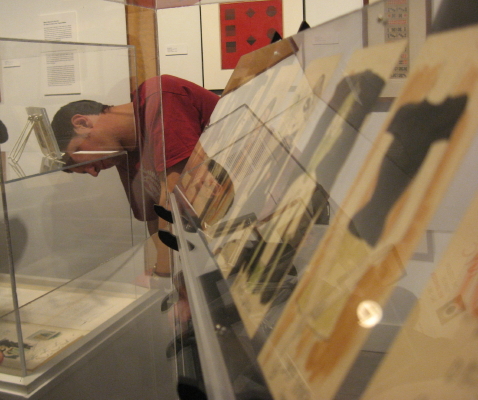
Ray Johnson’s career had many layers, and two essays by old friends of Ray offer insight into his early days in Detroit and his heyday in the East Village. Arthur Secunda contributed much material for the show and portrays in his recollection “Ray Johnson’s intelligence, mysterious youthful verve and artistic ingenuity.” William S. Wilson, the primary lender of the collage works, and one of Ray’s long-time art buddies, makes his essay a tour de force in Ray J style quirkiness and abrupt juxtapositions. He says “Ray Johnson was a student of the imaginations of other people.” He ably describes Ray’s focus not on abstract ideas but direct concrete responses, because Ray “worked to remain within immanences, eluding transcendentals.”
Two academic writers share their ideas about the inportance and significance of Ray’s work. Julie J. Thomson thoroughly documents the large and lasting influence Josef Albers had on Ray’s work. She also describes the way Ray’s work related to the “Happenings” and other art trends of the times. Kate Erin Dempsey, in “Code Word:Ray,” shared a long excerpt from her work in progress about Ray and his reaction to and use of the fad for secret codes and hidden messages raging in the 1950s. Expanding on the fascinating work she shared at the BMC conference, she convincingly demonstrates Ray’s fascination with language and its manipulation for artistic purposes. Furthermore, she follows this thread from radio show decoder rings through the Mayan hieroglyphics and glyphs revered at BMC, to Ray’s mature use of found images – giving them a “new lease on life – enhancing or altering their meaning entirely by arranging them in novel ways.” Kate’s work at the BMC conference, this essay, and hopefully her future book will all warrant future Ray J posts.
The kernel I found that connected all these essay? Nothings – empty shells of meaning – e.g. nonsense – that serve as markers and triggers for the kind of nonlinear art experience Ray Johnson wanted you to have. William S. Wilson talks of “the surface concealed only by another surface.” Julie J. Thomson finds their roots in “the gap, an element emphasized by Albers in his teaching,” and makes the valid and often repeated connection between Ray’s study of Taoism and these ideas. Kate Dempsey makes it clear Ray wanted to avoid specific meanings, sending messages in bottles to be partly constructed by the finder. Sebastian reminds us that Ray was “an autodidact student of Buddhism and a self-described disciple of John Cage’s cultivation of chance occurrence. ” Julie Thomson describes the performances Ray created entitled “Nothings:” they “interrupted the Happenings, opening up a space amidst the busy environments and experiences of the Happenings.” Ray brought Zen and his unique fusion of life and art into American art, and made his mark with great gifts and energy.
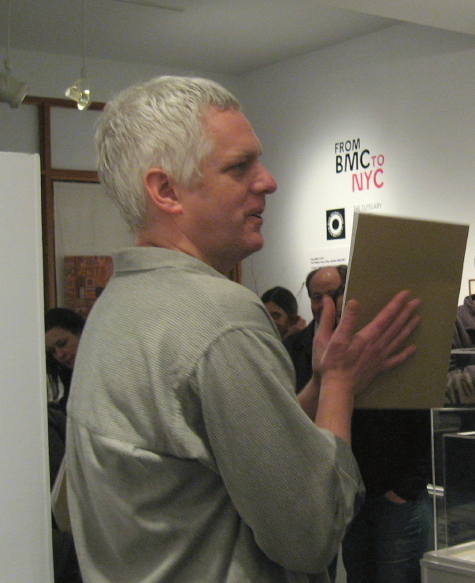
Sebastian Matthews, curator of the Ray Johnson show
Sebastian Matthews has provided an amazing set of Ray Johnson experiences to me , starting with the BMC conference, many kind and enthusiastic interactions, and now this multiple-event, long-running show. He did all the myriad tasks and jumped through all the hoops to make this show happen, but he clearly handled the situation as a working artist and remained beautifully true to the spirit of Ray Johnson with everything he did as a result. See this show and then follow Sebastian’s advice:
Don’t get too caught up in finding meaning in every little detail. You need to first catch a drift of the mood and follow it back in. Let the work show you how to see. Let Ray work his magic. Sebastian Matthews, from BMC to NYC
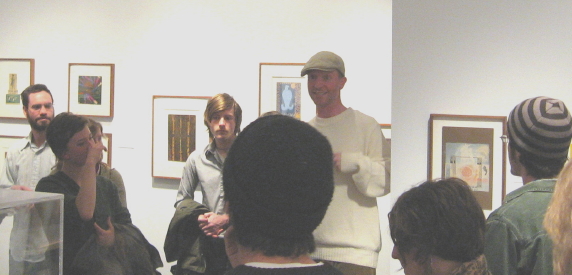
Graham of Poetix Vanguard offers spoken word to the Ray J crowd
The event was a blast and was just the beginning. Remember the show runs til June 12th, and there are lots of special events to help motivate the trip. A collage workshop by Krista Franklin had occurred by this post, a screening of How to Draw a Bunny, an award-winning Ray J documentary will take place on April 8, and Dr. Francis F. L. Beatty, a curator who works with the Ray Johnson Estate, will speak about Ray’s work on May 21. The show will celebrate its closing with a poetry reading on June 12th. The Black Mountain College Museum and Art Center, sponsor of all events, has just announced a fascinating weekend event at the old dining hall building on the BMC campus. Sounds fun! BMC lives!!
Black Mountain College Continues to Inspire, Fascinate
Black Mountain College and BMC+AC, the Asheville museum and art center devoted to its memory and influence, continue to generate artistic and literary responses that reverberate with the powerful cultural forces that coursed through the college until 1957. An upcoming show at the Asheville center will feature Ray Johnson, whose personal correspondence with me is described on my Black Mountain page. I am looking forward to attending and writing about the show, whose curator, Sebastian Matthews, was so welcoming and enthusiastic at the recent BMC conference. He started a blog just for this show and it’s full of wonderful Ray J images and stories. Much more about Ray Johnson before and after the show in February.
From BMC to NYC: The Tutelary Years of Ray Johnson (1943-1966)
*************
Jonathan Williams feature by Jeffery Beam and Richard Owens
Jeffery Beam, UNC botanical librarian and Hillsborough poet, has made a major contribution to Black Mountain documentation with his recently posted Jonathan Williams archive, which gathers a wide selection of photography, poetry and essays in order to capture the unique vision of Jonathan Williams. Jeffery and Richard describe the scope of the project below.
The work he produced for more than half a century is such that no one activity or identity takes primacy over any other. He is never only a poet or photographer, an essayist or publisher. What we find instead in the figure of Williams is a continuity that cuts across these practices — something we might call a poetics of gathering. All of his efforts are linked through an unswerving desire to collect and preserve, harvest and distribute.
The project, which resides at Jacket Magazine, includes a photo essay, past essays and new pieces in response to Williams’ death in 2008 or commissioned for this project. More details from Jeffery:
You’ll also discover 26 portraits of Jonathan from the age of about 12 up until 2005 – with other images scattered throughout the essays, 24 photographs by Jonathan – a number of which have never been published, works of art in honor of Jonathan, an unpublished interview with Jonathan by editor Richard Owens, a complete Jargon bibliography by Owens, and a selected Jonathan Williams publications bibliography compiled by me from a forthcoming complete bibliography. Jeffery Beam
*************
Raleigh has some small claims to fame relative to Black Mountain lore. Long before Glenwood South became known as an art center, Gilliam & Peden Art Gallery on Glenwood Avenue organized a show, curated by Ben Williams, called Black Mountain Connection. It featured Josef and Anni Albers, John Cage, Willem de Kooning, Franz Kline, Robert Motherwell, Kenneth Noland, and Robert Rauschenberg, as well as many others as seen below. This is my copy of the prospectus for the 1987 show.
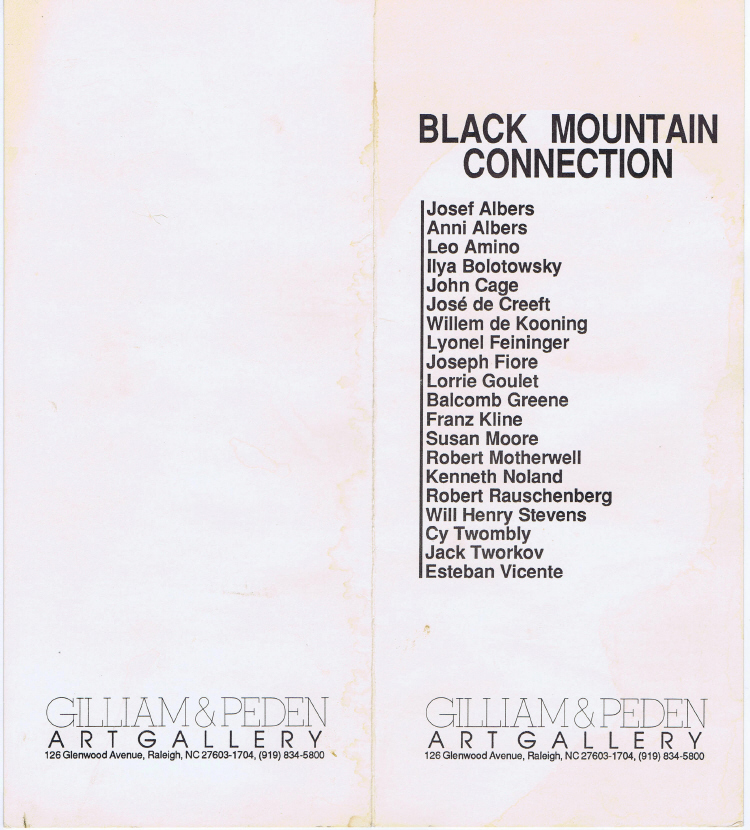
(click to enlarge)
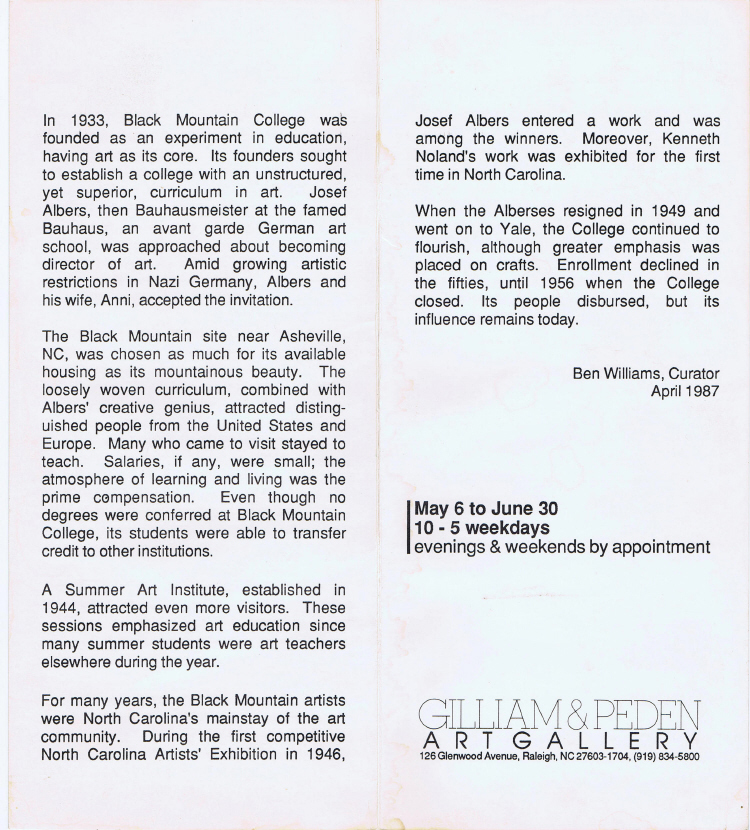
The NC Museum of Art hosted a major exhibition of BMC material in 1987. In conjunction with this show, which also traveled to Annandale-on-Hudson and New York City, New York, , MIT Press published a truly sumptuous volume entitled The Arts at Black Mountain College by Mary Emma Harris. The book is wonderful, but I’m pretty sure it doesn’t now come now with the checklist of the exhibition which is tucked inside my copy from the show. Looking over it, I recall the intense immediacy evoked by the multitude of so many different kinds of objects in that show. There were architectural models, prints, oils and products of every imaginable drawing device and surface; announcements, bulletins, programs, photographs, glyphs, scores, weavings, calligraphy, letterpress printings and bound books. You got a sense of the interspersing and practical (yet clearly micro-utopian) productivity of this self-contained culture studying culture. The exhibition, The Arts at Black Mountain College 1933-1957 was organized by the Edith C. Blum Art Institute of Bard College and contained 219 items.
NCSU’s Gregg Museum has also done its part for BMC. Anni Albers was featured in a 2007 lecture (links to pdf) by Mary Emma Harris (who had previously lectured there about the architecture of Black Mountain). The NCSU Colleges of Textile and Design offers specialized degrees combining design and technology through the Anni Albers Scholars Program, which “is named for a designer who exemplifies the ideals and goals to which the program aspires: textile designer and artist Anni Albers.”
**************
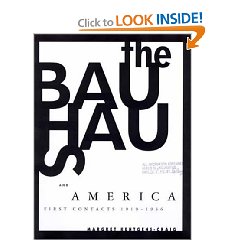
- Margret Kentgens-Craig’s book
Yet another local connection to the threads of BMC influence is Margret Kentgens-Craig, part-time Raleigh resident (and fondly remembered stalwart supporter of my Paper Plant bookstore), whose book The Bauhaus and America: First Contacts 1919-1936 delineates the major connections between the Bauhaus and Black Mountain College. Walter Gropius, a nine year director of the Bauhaus, lectured at the college, but also “tried continually to secure a teaching position at Harvard for Josef Albers.” Lucky for BMC he didn’t! Albers, according to Kentgens-Craig, “was the first Bauhaus master to acquire a position at an American educational institution, Black Mountain College. His wife Anni, who was Jewish, joined him.” The book describes the enormous impact Bauhaus ideas had on American architecture, and credits Lawrence Kocher, a BMC instructor, with creating opportunities for the dissemination of those ideas.
*************
A final BMC note: Jeff Davis posted recently at his blog Natures previewing the Charles Olson Centenary Conference, taking place at Simon Fraser University in Briitish Columbia June 4-10, 2010. Jeff will be in Vancouver “to make a presentation on Olson’s curricular projects.”
*************
Black Mountain College Conference
The greatest thing a human soul ever does in this world is to see something and tell what it saw plainly. John Ruskin
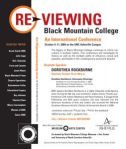
The conference held in Asheville October 9-11 about Black Mountain College and its legacy was a stunning success. A myriad of diverse presenters joined with performers, poets and artists to celebrate the influence of the college and the accomplishments of its alumni, both teachers and students. A collaboration of The Black Mountain College Museum + Art Center and UNC-Asheville, the conference was a long-awaited gathering of energies from across the country and beyond, searching for the memory and meaning of Black Mountain College.
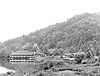
BMC existed just 24 years, from 1933 to 1957, but this conference made clear that its radical vision of education and incredible nexus of creative individuals resonates deeply in our arts and culture. There were so many threads of research and inquiry presented, I can only speak of my own journey through the presentations. Planning to focus on Ray Johnson, I found myself captured by powerful ideas about the basic philosophy and significance of BMC, and intrigued by new perspectives on the creative processes which emerged there.
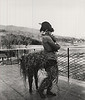
Initially, students at BMC were required to take only 2 courses: philosophy from John Andrew Rice and art from Josef Albers. Rice’s philosophy, informed by John Dewey, created a new mode of education at BMC, one that featured the internal discipline generated by students doing as much as absorbing. Michael Kelly’s presentation on Dewey in relation to BMC brought out the powerfully humanistic nature of liberal arts education as conducted at BMC. With art central to his view of experience, Rice designed the curriculum to elevate the quality of experience in students until they were prepared to be democratic citizens. Seymour Simmons helped connect the educational philosophy to the artistic act with this wonderful description of the act: “an inventive response to genuine problems involving collaboration and conflict while engaging and integrating multiple human capacities.” Josef Albers wanted for his students no more or less than a new mode of seeing, and his manifest genius was the nugget of magnetism that drew such stellar powers to the place.
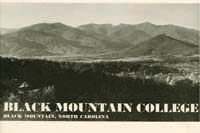
The place! Over and over the theme of place ran through the conference. Black Mountain was a unique haven of sorts, and a bivouac as well for the sorties against New Criticism and the strictures of Modernism. It was literally a quiet spot in the harried life of urban artists and teachers who came. Yet there were privations, great stress, and no assurance of the fame and influence we look back on today. Two living Black Mountain figures, Dorothea Rockburne and Michael Rumaker, presented at the conference and helped establish the sense of the place.
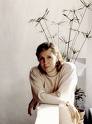
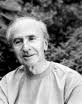
I found the presence of two deceased BMC figures, M.C. Richards and Ray Johnson, to be very strong due to the passionate work being done on them by current young scholars. M.C. Richards embodied the highest principles of the Dewey aesthetic in seeing and living the connnection between art and life. Jenni Sorkin of Yale University described Richard’s costly rejection of a conventional academic career for the esoteric but rewarding concepts of Rudolph Steiner and Matthew Fox, the “Centering” of being required for art in clay,and the attempt to practice the apprenticeships of art to prepare for “the big art… our life.” Kate Dempsey and Sebastian Matthews both offered invigorating interpretive perspectives on Ray Johnson, and convinced me once and for all that Ray is the epitome of Black Mountain students, and carried into the world a fundamental store of post-modern concepts gained at Black Mountain.
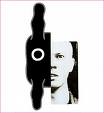
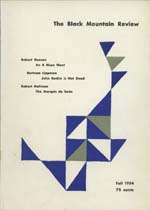
More than one speaker described the roots of post-modern thought to be discerned in the Black Mountain canon. Andrea Lui from NYC named three: 1) knowledge as contingent and partial, 2) photography as art, and 3) promiscious mixing of disciplines. The relation between and hierarchy of the disciplines at BMC provided some interesting contention among the scholars. Speaking of the interdisciplinary approach, Louly Peacock Konz offered perhaps the most purely entertaining talk of all with her description of the play “The Ruse of Medusa,” translated from Satie’s French by M.C. Richards, and performed by Buckminster Fuller as the baron and Merce Cunningham as the “costly mechanical monkey,” among others. Black Mountain College established a perceived “school” of poetry, encompassing authors who never set foot on the campus. Rachel Stella from Paris described the Black Mountain Review as the base for a “textual community” which helped transform the structure of literary publishing of the era. Charles Olson’s massive literary influence came up again and again, with Jonas Williams of SUNY-Albany reminding us that Olson said: “art does not describe, but enacts.” Forming, transforming, teaching by action, seeking the transcendent in the material: these were the forces that coursed through education at Black Mountain. Over several near-future posts, I will recount some of the amazing insights shared at this conference, especially my greatly enlarged perspective on Ray J. The central role of experience in learning and the intellectual freedom derived from Socratic and democratic principles were key elements in Black Mountain’s existence and lasting influence. From this cauldron of intellectual striving and artistic practice emerged various and wonderful creative expressions with much to tell us today. This conference did not dissect a historical movement, but uncovered living roots of a vital cultural force that sends wick green shoots upward as we speak.
We must carry in our souls a picture of creating little by little
the vessel of our humanity. M.C. Richards
A Raleigh Art Ramble

The Paper Plant presents an Open Studio Saturday, August 22 from 10 AM to 6 PM. John and Cara will be demonstrating papermaking, marbling, printmaking and letterpress printing. A retail display of notecards, blank books and paper, with opportunities for hands-on interactions.
528 N. Person Street, 919-618-6883
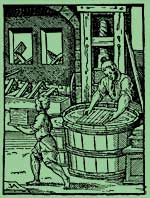
Starting with the shameless self-promotion above, here is my current outlook on Raleigh creative endeavors. I dearly hope our open studio will attract (as it did last year) some of my Bain friends, new and old. Critter, a Bain documentor, has favored me with some mail art this summer and I’m dying to show him the new Ray Johnson material I picked up recently at the Black Mountain College Museum + Art Center. Ray’s mail art show in 1976 was seminal for me: my Bain experience was galvanizing in just as big a way, here in my old age. I hope our open studio can stimulate: we will be marbling, printing and making sheets, and at 6 PM we will toast the day with all who have gathered. Please come!
******************

Lovejoy Pottery, August 1st, 9-4
Dan and Nancy Lovejoy are having an open studio this coming weekend at Lovejoy Pottery in Wendell. I posted about their show last summer in the first weeks of this blog’s existence, and it’s always great to see them and the other artists, who include Edge Barnes, John Garland & Mary Paul, Alan Leland, Julie Olson, Susan Myers, and Nancy & Kathleen Redman. As described in the earlier post, Dan Lovejoy was a founding member of Raleigh Artists Community in the seventies, and the Lovejoy Pottery show is well worth the drive to 6117 Watkins Road off Rolesville Highway. (919)266-6053.
***************

David Beaver, media theorist
I had the best chat with David Beaver the other day at Borders. David earned eternal endearment in the Raleigh art community by acting as jovial scorekeeper for the Poetry Slams at Forum+Function in the late nineties. He is my emblem for a 21st century shaman, being a magician, virtual reality enterprenuer, and now key member of the emerging Overview movement, which posits that seeing Earth from space is so life-changing, common space-flights could fundamentally change humanity’s perspective on the planet. Though David is working on transforming the world, he is still affable and charming as ever, and he’s got my mental cogs churning about several of his fascinating ideas.
******************
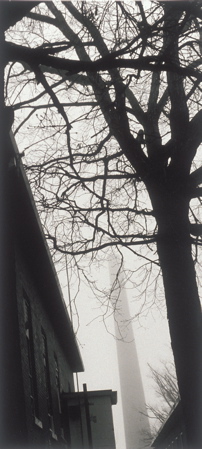
photo by David Simonton
NandO featured David Simonton recently and turned me on to a fantastic blog – Prison Photography, now featured on my blogroll. Their post about David’s photographs of Polk Youth Center before it was razed for the art museum shows powerful work; a stark portrait of neglect and abandonment. David’s earlier photographic work reflects “his calling as a poet of the ignored or the ruined place, the lost or forgotten landscape,” as described in this Indy profile.
***************
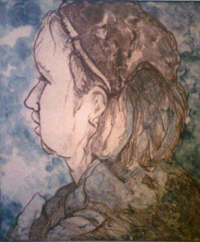
by Susan Soper
Below is a sending from Susan Soper, printmaker.
Susan Soper — Lithographs
Clayton Center Gallery
Clayton, NC 27520
August 1-30 2009
Gallery Hours M-F, 9-5
Public opening reception Thursday August 6th, 6–7:30 pm
Sponsored by Clayton Visual Arts
***********
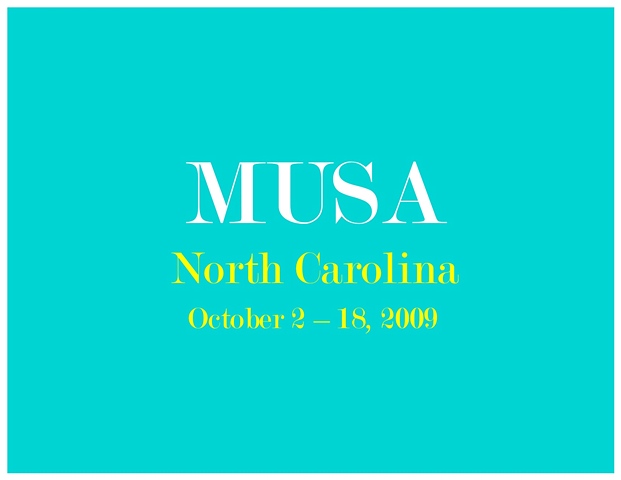
Carter Hubbard, a papermaking contact from way back, touched base recently about an interesting project. She and partner Sara Botwick are putting together an art exhibition in the downtown warehouse where Bill and Otho created “antiques” for Niemann-Marcus and employed several dear friends in the process. The MUSA website is a bit inscrutable, but the show will offer an “interpretive visual perspective … on what it means to be ‘made in the USA.'” I’ll get back to this project soon.
*********
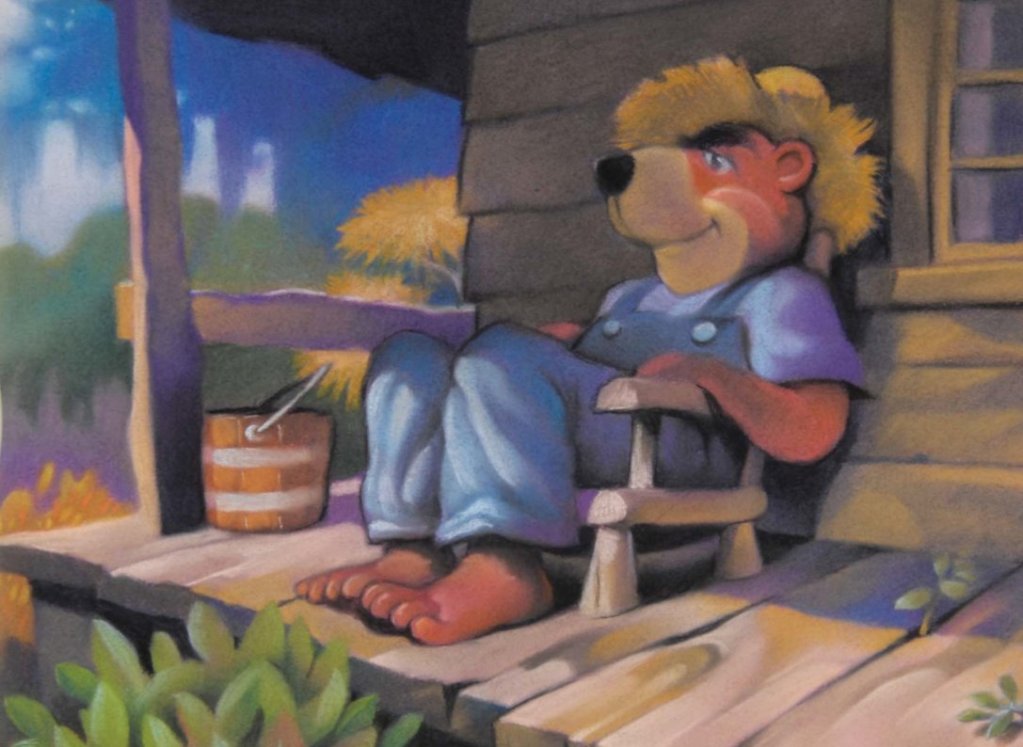
Poppy Bear on Porch by Walter Stanford
Joel Haas just held a signing for his new book, Poppy Bear, illustrated by Walter Stanford. Joel’s book is his own writing, based on the “most enduring character” of his late father, the prolific novelist Ben Haas, who entertained his three boys with endless “Poppy Bear” tales but never wrote them down. Joel wrote up a prototype “Poppy Bear” story and then hooked up with Walter. The book is available from either of their websites.
**************
Thanks for your kind attention. As always, this is just a smattering of the wonderful Raleigh culture that has come my way. Back at ya’ soon!
raleighrambles.com
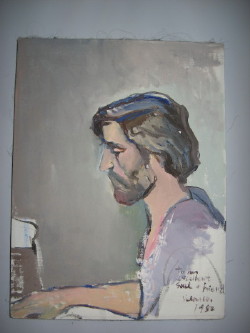
portrait by Guillermo Velasco


 Raleigh Rambles
