Petrblt – Peter Eichenberger holds forth no more
Scientia aurea — Knowledge is Golden
Peter Eichenberger died Thanksgiving morning and proved well his enduring unique qualities with the breadth and nature of his mourning. Just one of those qualities was: if you were ready for it, Peter was down with it, and so he made many many friends. They have mourned the loss of his excellent company and all he might have said, but celebrated a life lived full speed and damn the torpedoes, smelling the roses and leaving no stone unturned along the way. Teasing and sarcasm was our way, as with many, and he would hate those cliches, but he was a man worthy hyberbole, since his life consisted of it.
I feel very lucky to have explored Cameron Park’s myriad of alleyways on bike with him this summer, and glad that I shared so many drinks at Sad’s with him, and I hate like the dickens I never got him together with my dad, whose stories of Depression downtown Raleigh and Southern Railroad energized him any time I touched on them. He could ably discurse on innumerable subjects, and he taught me much. He reminded me that Willie York had ditched and piped Pigeon House Branch to build the first shopping center in the Southeast when I was writing about that troubled creek, and he explained to me that the “geodesic” dome I liked so much at the Fairgrounds was actually made of hexagons (instead of pentagrams like Bucky’s). He could write in the Downtowner of dog history and at Metro of Raleigh history and in the Indy of technological history, but I loved to hear him talk of cultural history and the local media history he had lived with all these years. He was a writer, Raleigh’s own Gonzo, but he was rooted in the Earth by what he could do with his hands, which was just about anything if he wanted to.
What he wanted was for the world to be right and what he knew was that the world is very very screwed up. He was right, and when those dark spectres bothered him he would share about the Mayan prophecies or the bombed levees or some other conspiratorial tale that bothered some but seemed clearly to be metaphors: the world is very very screwed up.
Peter also gathered the best kind of vibes and lived in the harmony of many positive energies. Thus was he beloved and is honored by so many in the words that have flowed since his passing. He leaves behind many words of his own, but scattered over the town of Raleigh (and the world wide web) like raucous crows, singing a noisy chant of art, art for life, art against the controlling state and the corporate fascists, art for love. Peter love Peter.

Here are some of the many links for the outpouring online for Peter and links for his own writing:
Peter’s wonderful narrative in the Indy post accident
The Second Battle of New Orleans: notes of a bike repair warrior
remembrance by Indy’s Shirlette Ammons
Peter’s article archive at The Indy
Peter’s articles at Metro magazine
posts by Peter at Goodnight Raleigh
Peter’s articles at New Raleigh
Mark Kuykendall’s remembrance at New Raleigh
New Raleigh’s Memorial post w pics and words from many
NandO news article about Peter’s death
Lyrical Language Adventure

illustration by Christine Noad
Passejada Menerbesa / Wild Roman Byways
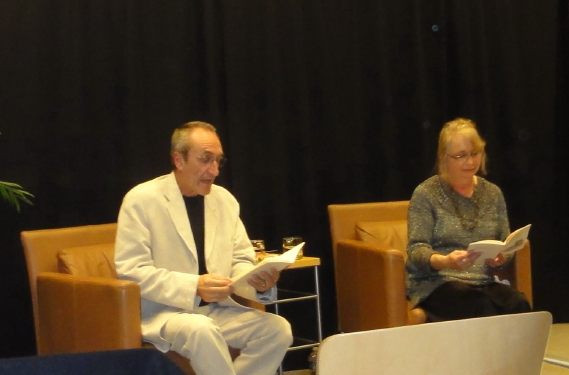
Miquel Decor reads his poetry
Hearing Miquèl Decòr read his poetry in Occitan, the ancient French language of the troubadours, was an amazing experience. Listening to him introduce each poem in French, than having his translator Jeannette Rogers say all of it in English, made it an amazing language experience. I went overboard at his performance in Chapel Hill and sight read my copy of Wild Roman Byways, his book, as he read his work. I continually glanced over at the French and English (a wonderful chapbook for a linguist) and nearly made myself sick. It was worth it, but when I heard him read at Meredith College I simply listened and it was just as wonderful. What an energy this man has, this retired schoolteacher from the countryside of southern France who has become a voice in his nation for the language of Oc. Wild Roman Byways describes the physical mileu of ancient Roman sites within a day’s journey of the author’s home. As he evokes the grass-bearded stone ruins and the rough bridges and grottos, he finds the imagist and musical gems in these landscapes and molds them into song. Miquèl does sing, and play, in fact has performed literally for the crown heads of Europe, and his presentation of poetry was a true performance.
Jeannette was so brave and effective as she matched up to her author with her English translations. She read them aloud beautifully and her translations read strongly – having no French, I can’t judge the actual translating, but the English poems are lovely, with such a grip on the natural world.
Below is a sample of this three language experience – Oc, French ,English.
Ma votz se vòl tamborn e resson de dalhaires,
E se pèrd dins los aires…
………..
Ma voix se veut tambour et ècho de faucheurs,
et elle se perd, dans les airs…
……..
My voice seems to throb and to echo with the sound
of reapers, then, becomes lost in the wind…
When the reading shifted away from Roman Byways to the lyrical love poetry more typical of Decòr’s work, the tone changed. Here he was even more demonstrative, and the intriguing qualities of the Occitan were more prominent. The poems were very masculine (think imagist Robert Bly) and the linguistic tones were somewhat Germanic, sometimes almost guttural. This was amazing to hear from the mouth of a Frenchman, and was one of many things about the whole experience that enlarged my perspective on the French character. Miguèl is immersed in the southern French countryside, and spoke passionately at the Chapel Hill reading about the history of Occitan in France and his own relationship to Paris and traditional French national culture. His parents forbade him to speak Oc but he learned it anyway from his godfather and has become one of its champions. There are Oc immersion schools in southern France, and Miguèl makes media appearances and participates on a national level with the preservation of the language.
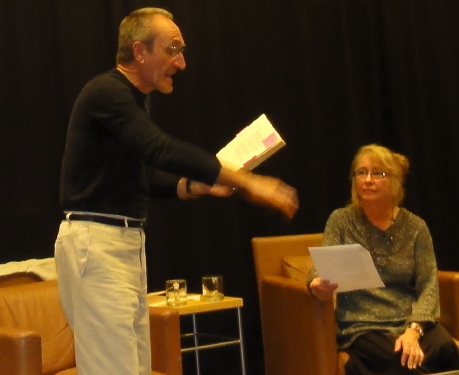
Kudos to Jeannette for bringing this fascinating man to Raleigh and facilitating his poetry presentations – as well as translating and reading the poems! We will be hearing more of Jeannette as she continues her literary journey through the France of the troubadours.
To order a copy of Miguèl’s book, contact her:
jeannette.rogers(At)gmail.com
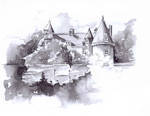
chateau en Minervois
Modern Troubadour and Local Translator Present Occitan to Triangle
In October, the Triangle will be entertained by a true modern-day troubadour. Miquèl Decòr, a prolific and original poet who carries on the ancient literary tradition of writing and performing in the Occitan (Oc) language, will be sharing his works at poetry readings in Raleigh, Chapel Hill and Pittsboro.
The poet and his translator, Raleigh resident Jeannette Rogers, will read in Occitan and English from two of his books which Rogers translated, “Wild Roman Byways” and “Heirs of the Moon.” These poetry readings, a collaboration between Meredith College and the Center for European Studies at The University of North Carolina at Chapel Hill, are free and open to the public:
- Tuesday, Oct. 5 at 7 p.m., Global Fedex Center, UNC-Chapel Hill, Chapel Hill, N.C.
- Thursday, Oct. 7 at 7 p.m., The Joyful Jewel, Pittsboro, N.C.
- Thursday, Oct. 14 at 8 p.m., Carswell Concert Hall, Meredith College, Raleigh, N.C.
Decòr is a native and resident of the Languedoc region of France where the troubadours lived nearly a thousand years ago. From the 11th through the 13th centuries, 500 troubadours wrote and performed in Occitan throughout Europe. During that time they invented many forms of poetry, as well as biography and literary criticism, while they shifted the focus of literature in Western Europe from war to love. Modern Oc poets provide the connection to the significant literary heritage of the troubadours.
The author of 10 books, including poetry, drama and history, Decòr has been involved in many French cultural events and appeared on French television and radio. This is the poet’s first visit to the United States.
The information above is from Jeannette Rogers, who translates Decòr’s work and arranged for his visit to the U.S. Jeannette is a dear old friend who is fluent in French and creating a wonderful body of work as she develops historical novels set in medieval southern France and translates French and Occitan poetry.
Occitan is a Latin-sounding ancient version of the French tongue, one of the many endangered languages around the world. Miquèl Decòr and my friend Jeannette, who is learning Occitan as she translates it and works with Miquèl on trilingual presentations of poetry, are important figuress in an emerging renewal of of the language in French culture. As UNC’s press release states:
He was bathed in the culture of Occitan from his birth under the spell of his godfather, Uncle Jean, an actor. When he left home to study in Béziers, distance and longing caused him to write poetry in Occitan, his mother tongue.
Decor press release (loads pdf)
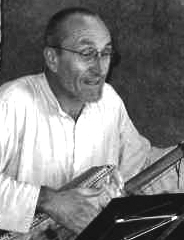
Miquèl Decòr
Ray Johnson: Tracking Deep Currents
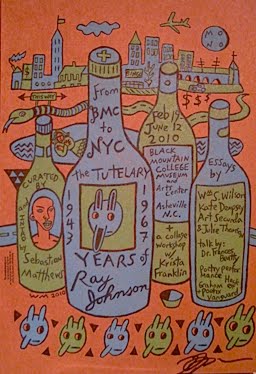
The Ray Johnson show at the Black Mountain College Museum in Asheville opened February 19th and will run through June 12, 2010. The opening was spectacular, the show is rich, varied and informative. For Ray J fans like me, the catalogue and it’s essays, assembled by show curator Sebastian Matthews, is the real treasure. Sebastian spent over a year studying Ray’s life and work, making connections with important people in Ray’s life (Ray passed in an act of suicide in 1995), and establishing his own perspective on the evolution of Ray’s art from a young art student in Detroit through a strong experience at Black Mountain College to an important role in the art scene of East Village in the 60’s and 70’s. The show displays extensive early work, including fairly typical ink doodles of 14 year old Ray, but also hilarious cards and visual puns from this period that presage his later work.
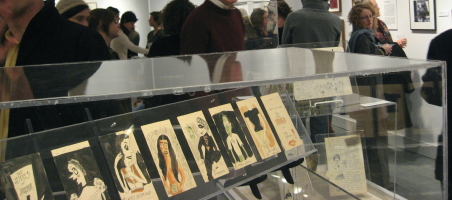
The show also reveals the aspect of Ray’s work I most needed to learn myself – that Ray came of age as an artist in the painterly traditions BMC and Josef Albers provided, and did lots of wonderful work as he evolved from painting to collage and then on to the correspondence work or “postal performances,” as Isa Bloom calls them, which made him most famous. The show focuses on Ray’s emergence out of Black Mountain College into the New York scene immersed in the ideas of his BMC mentors but prepared to follow Alber’s dictum: “to follow me, follow yourself.” As Sebastian Matthews says in his catalogue essay, “Ray was ripe for the challenges and experiences Manhattan had to offer.” He became one of the most intriguing and complex artists of the 20th century, and this show delineates many of the roots and threads that set him on his path.
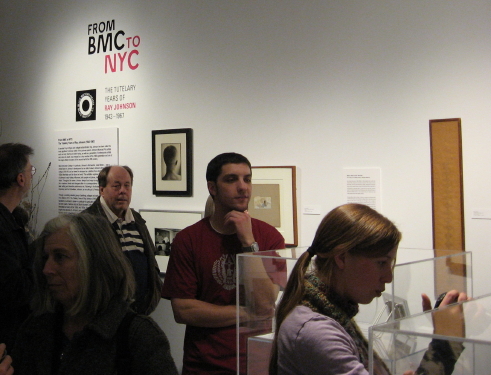
The opening of the show was well attended and featured some aspects Ray might have liked very much, though he generally was quite ambivalent about exhibiting or selling or even saving his work. Poetix Vanguard offered spoken word performances during the event, and an open mike followed at a bar nearby. The BMCM+AC library, with many Ray J items prominent, provided a nice context for the highly varied show. Several of Hazel Larsen Archer’s gorgeous photos of Ray at BMC were on display. And Sebastian Matthews, collage artist himself and so clearly a Really Great Guy, presided with enthusiasm over the many energies he had gathered to celebrate the amazing career of Ray Johnson.
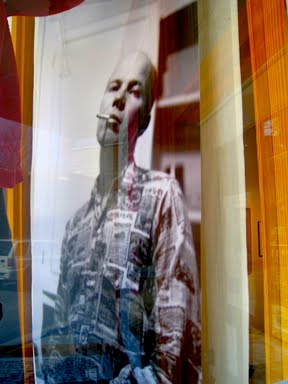
Ray J show window display at BMCM+AC
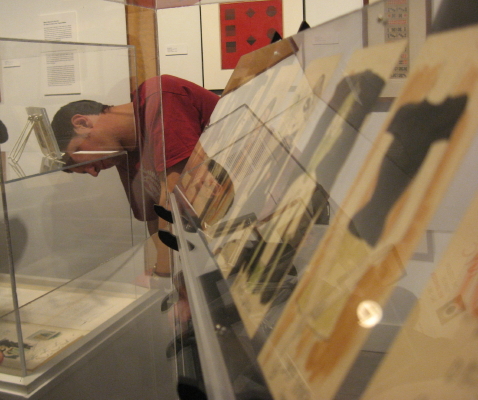
The catalogue contains 46 color plates, over a dozen images in the text, and several of Archer’s photographs. It also contains an interactive feature: a pair of postcards bound in as endpapers which the reader is invited to alter as desired and send off: one to a friend and one back to The Black Mountain Museum and Arts Center, whose program director Alice Sebrell is credited by Sebastian as being integral and vital to the process of creating the show. Five essays offer views of Ray that are remarkably varied and complementary.
Sebastian Matthews presents his curatorial essay as nine journal notes written while building the show. He elaborates his basic point: that Ray Johnson “used Black Mountain College as a springboard to propell himself into the Manhattan art world.” He also does a remarkable job, with his intense self-examinations, numerous concrete biographical insights, and constant awareness of Ray’s own probable intent to be inscrutable, of helping us have a “fuller sense of what Ray attempts when he sits down to make art, when he prepares to send out the work to be received, passed on, altered.” The quote is what Sebastian hopes to accomplish with the show, and I think he got there. He also truly transformed my personal sense of Ray J by portraying the intense, painterly, quite technical control Ray exerted over his collage work.
Ray Johnson’s career had many layers, and two essays by old friends of Ray offer insight into his early days in Detroit and his heyday in the East Village. Arthur Secunda contributed much material for the show and portrays in his recollection “Ray Johnson’s intelligence, mysterious youthful verve and artistic ingenuity.” William S. Wilson, the primary lender of the collage works, and one of Ray’s long-time art buddies, makes his essay a tour de force in Ray J style quirkiness and abrupt juxtapositions. He says “Ray Johnson was a student of the imaginations of other people.” He ably describes Ray’s focus not on abstract ideas but direct concrete responses, because Ray “worked to remain within immanences, eluding transcendentals.”
Two academic writers share their ideas about the inportance and significance of Ray’s work. Julie J. Thomson thoroughly documents the large and lasting influence Josef Albers had on Ray’s work. She also describes the way Ray’s work related to the “Happenings” and other art trends of the times. Kate Erin Dempsey, in “Code Word:Ray,” shared a long excerpt from her work in progress about Ray and his reaction to and use of the fad for secret codes and hidden messages raging in the 1950s. Expanding on the fascinating work she shared at the BMC conference, she convincingly demonstrates Ray’s fascination with language and its manipulation for artistic purposes. Furthermore, she follows this thread from radio show decoder rings through the Mayan hieroglyphics and glyphs revered at BMC, to Ray’s mature use of found images – giving them a “new lease on life – enhancing or altering their meaning entirely by arranging them in novel ways.” Kate’s work at the BMC conference, this essay, and hopefully her future book will all warrant future Ray J posts.
The kernel I found that connected all these essay? Nothings – empty shells of meaning – e.g. nonsense – that serve as markers and triggers for the kind of nonlinear art experience Ray Johnson wanted you to have. William S. Wilson talks of “the surface concealed only by another surface.” Julie J. Thomson finds their roots in “the gap, an element emphasized by Albers in his teaching,” and makes the valid and often repeated connection between Ray’s study of Taoism and these ideas. Kate Dempsey makes it clear Ray wanted to avoid specific meanings, sending messages in bottles to be partly constructed by the finder. Sebastian reminds us that Ray was “an autodidact student of Buddhism and a self-described disciple of John Cage’s cultivation of chance occurrence. ” Julie Thomson describes the performances Ray created entitled “Nothings:” they “interrupted the Happenings, opening up a space amidst the busy environments and experiences of the Happenings.” Ray brought Zen and his unique fusion of life and art into American art, and made his mark with great gifts and energy.
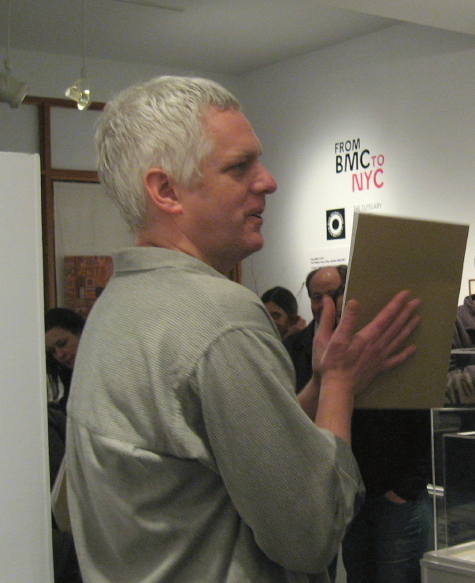
Sebastian Matthews, curator of the Ray Johnson show
Sebastian Matthews has provided an amazing set of Ray Johnson experiences to me , starting with the BMC conference, many kind and enthusiastic interactions, and now this multiple-event, long-running show. He did all the myriad tasks and jumped through all the hoops to make this show happen, but he clearly handled the situation as a working artist and remained beautifully true to the spirit of Ray Johnson with everything he did as a result. See this show and then follow Sebastian’s advice:
Don’t get too caught up in finding meaning in every little detail. You need to first catch a drift of the mood and follow it back in. Let the work show you how to see. Let Ray work his magic. Sebastian Matthews, from BMC to NYC
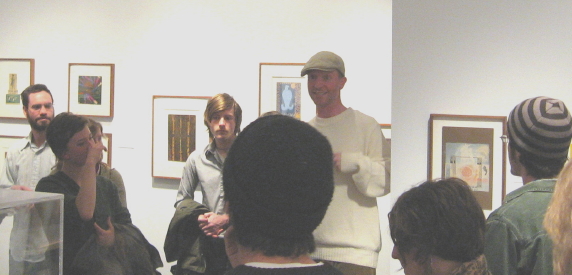
Graham of Poetix Vanguard offers spoken word to the Ray J crowd
The event was a blast and was just the beginning. Remember the show runs til June 12th, and there are lots of special events to help motivate the trip. A collage workshop by Krista Franklin had occurred by this post, a screening of How to Draw a Bunny, an award-winning Ray J documentary will take place on April 8, and Dr. Francis F. L. Beatty, a curator who works with the Ray Johnson Estate, will speak about Ray’s work on May 21. The show will celebrate its closing with a poetry reading on June 12th. The Black Mountain College Museum and Art Center, sponsor of all events, has just announced a fascinating weekend event at the old dining hall building on the BMC campus. Sounds fun! BMC lives!!
Black Mountain College Continues to Inspire, Fascinate
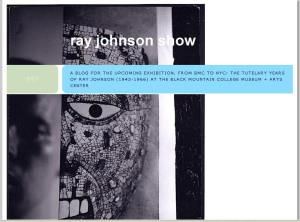
Black Mountain College and BMC+AC, the Asheville museum and art center devoted to its memory and influence, continue to generate artistic and literary responses that reverberate with the powerful cultural forces that coursed through the college until 1957. An upcoming show at the Asheville center will feature Ray Johnson, whose personal correspondence with me is described on my Black Mountain page. I am looking forward to attending and writing about the show, whose curator, Sebastian Matthews, was so welcoming and enthusiastic at the recent BMC conference. He started a blog just for this show and it’s full of wonderful Ray J images and stories. Much more about Ray Johnson before and after the show in February.
From BMC to NYC: The Tutelary Years of Ray Johnson (1943-1966)
*************
Jonathan Williams feature by Jeffery Beam and Richard Owens
Jeffery Beam, UNC botanical librarian and Hillsborough poet, has made a major contribution to Black Mountain documentation with his recently posted Jonathan Williams archive, which gathers a wide selection of photography, poetry and essays in order to capture the unique vision of Jonathan Williams. Jeffery and Richard describe the scope of the project below.
The work he produced for more than half a century is such that no one activity or identity takes primacy over any other. He is never only a poet or photographer, an essayist or publisher. What we find instead in the figure of Williams is a continuity that cuts across these practices — something we might call a poetics of gathering. All of his efforts are linked through an unswerving desire to collect and preserve, harvest and distribute.
The project, which resides at Jacket Magazine, includes a photo essay, past essays and new pieces in response to Williams’ death in 2008 or commissioned for this project. More details from Jeffery:
You’ll also discover 26 portraits of Jonathan from the age of about 12 up until 2005 – with other images scattered throughout the essays, 24 photographs by Jonathan – a number of which have never been published, works of art in honor of Jonathan, an unpublished interview with Jonathan by editor Richard Owens, a complete Jargon bibliography by Owens, and a selected Jonathan Williams publications bibliography compiled by me from a forthcoming complete bibliography. Jeffery Beam
*************
Raleigh has some small claims to fame relative to Black Mountain lore. Long before Glenwood South became known as an art center, Gilliam & Peden Art Gallery on Glenwood Avenue organized a show, curated by Ben Williams, called Black Mountain Connection. It featured Josef and Anni Albers, John Cage, Willem de Kooning, Franz Kline, Robert Motherwell, Kenneth Noland, and Robert Rauschenberg, as well as many others as seen below. This is my copy of the prospectus for the 1987 show.
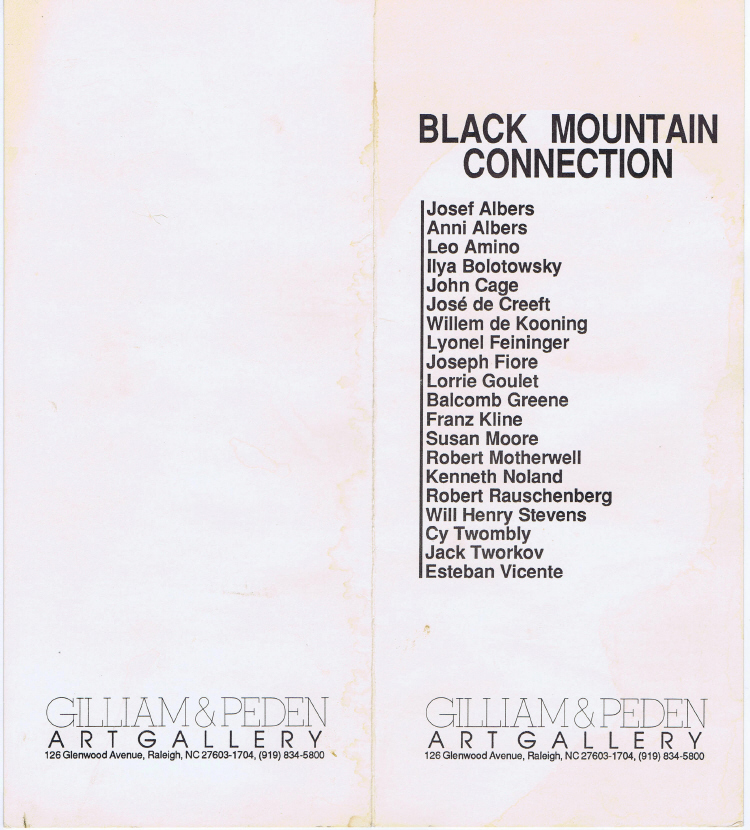
(click to enlarge)
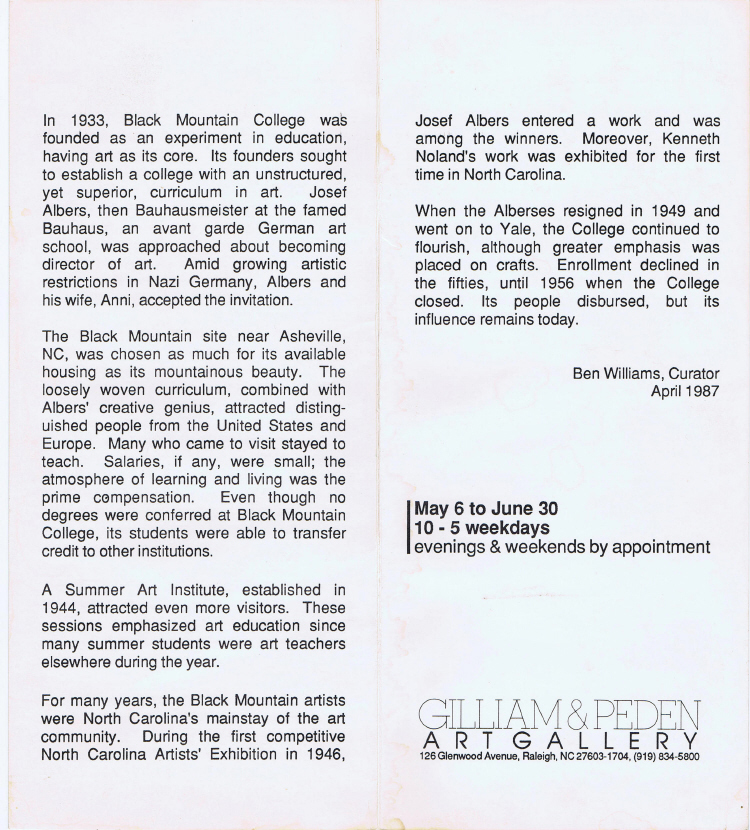
The NC Museum of Art hosted a major exhibition of BMC material in 1987. In conjunction with this show, which also traveled to Annandale-on-Hudson and New York City, New York, , MIT Press published a truly sumptuous volume entitled The Arts at Black Mountain College by Mary Emma Harris. The book is wonderful, but I’m pretty sure it doesn’t now come now with the checklist of the exhibition which is tucked inside my copy from the show. Looking over it, I recall the intense immediacy evoked by the multitude of so many different kinds of objects in that show. There were architectural models, prints, oils and products of every imaginable drawing device and surface; announcements, bulletins, programs, photographs, glyphs, scores, weavings, calligraphy, letterpress printings and bound books. You got a sense of the interspersing and practical (yet clearly micro-utopian) productivity of this self-contained culture studying culture. The exhibition, The Arts at Black Mountain College 1933-1957 was organized by the Edith C. Blum Art Institute of Bard College and contained 219 items.
NCSU’s Gregg Museum has also done its part for BMC. Anni Albers was featured in a 2007 lecture (links to pdf) by Mary Emma Harris (who had previously lectured there about the architecture of Black Mountain). The NCSU Colleges of Textile and Design offers specialized degrees combining design and technology through the Anni Albers Scholars Program, which “is named for a designer who exemplifies the ideals and goals to which the program aspires: textile designer and artist Anni Albers.”
**************
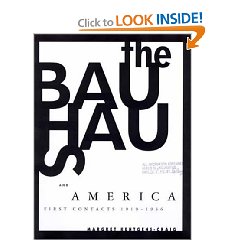
- Margret Kentgens-Craig’s book
Yet another local connection to the threads of BMC influence is Margret Kentgens-Craig, part-time Raleigh resident (and fondly remembered stalwart supporter of my Paper Plant bookstore), whose book The Bauhaus and America: First Contacts 1919-1936 delineates the major connections between the Bauhaus and Black Mountain College. Walter Gropius, a nine year director of the Bauhaus, lectured at the college, but also “tried continually to secure a teaching position at Harvard for Josef Albers.” Lucky for BMC he didn’t! Albers, according to Kentgens-Craig, “was the first Bauhaus master to acquire a position at an American educational institution, Black Mountain College. His wife Anni, who was Jewish, joined him.” The book describes the enormous impact Bauhaus ideas had on American architecture, and credits Lawrence Kocher, a BMC instructor, with creating opportunities for the dissemination of those ideas.
*************
A final BMC note: Jeff Davis posted recently at his blog Natures previewing the Charles Olson Centenary Conference, taking place at Simon Fraser University in Briitish Columbia June 4-10, 2010. Jeff will be in Vancouver “to make a presentation on Olson’s curricular projects.”
*************
raleighrambles.com
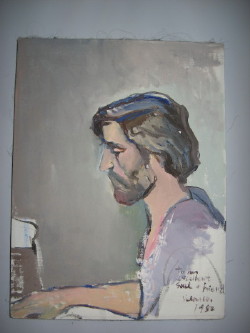
portrait by Guillermo Velasco


 Raleigh Rambles