Book Arts, Farming Fueled Black Mountain College
The 2013 Black Mountain College conference, held at UNC-Asheville, covered much ground, as always, with reflections and insights regarding the methods, influence and legacy of the experimental college that is both revered and obscured in the history of 20th century education and art. I always come away with one or more real breakthroughs in my thoughts about these topics, and this year the BMC farm program really came to light in the presentation of David Silver. Tom Murphy spoke of the print shop and letterpress operations, and both of these sessions offered rich, practical examinations of the processes and their implications. As always, the foundation of factual knowledge and interpretation laid down by Mary Emma Harris in her 1987 book, The Arts of Black Mountain College, is acknowledged and utilized by all presenters. Ms Harris continues to lead BMC research efforts, and presented this year about BMC approaches to material studies. She showed how the low-budget humble materials used by Anni Albers and others provided a freedom and at the same time an enforced discipline on the students. “You mustn’t forbid the possibilities of the materials,” and in the notes of Ruth Asawa from Josef Alber’s class, “the whole cosmos is entertaining”. These topics were applied to Asawa, BMC sculptural artist, by Jason Andrew, who showed how Ruth Asawa’s zero-based explorations of the culture of handicraft, and her highly artistic use of negative and positive space, helped lift craft into the perceived realm of art in the mid twentieth century. Christopher Benfey, the featured speaker whose ideas I discussed in the previous post, gave a keynote speech which emphasized a similar theme: “Starting at Zero!” Get your hands involved with available material. Then make an honest response to the materials, including the industrial process involved. The conference highlighted the synergy and profound influence derived from the joining of the design philosophy of Albers and the progressive education ideals of John Rice. Experiential education and the approach of design as a “form of justice between man and material” made BMC the birthing place of many new currents in American art.

David Silver presents about the BMC farm
The BMC farm was a rich source of experiential education, surely, and its operations offered many practical lessons in form and design. David Silver of the University of San Francisco described how students, with Ted Dreier’s supportive oversight, had a huge influence on the development of the farm. From Harris’s book: “In the first year [1934] a vegetable garden was started by Norman Weston [BMC student and “treasurer”] and other interested community members. The college leased a 25 acre farm with a vineyard and apple orchard…” John Rice was not enthusiastic but didn’t mind as long as faculty obligations were not needed. In 1938 the farm went to the future Lake Eden, was expanded in 1941 and by 1944 “was producing most of the beef, pork, potatoes, eggs, dairy products and some vegetables used by the college” (Harris again). Last year and this, Silver offered rich detail into how the farm emblemized the integrated systems, the balance of discipline and freedom, and the “use what you find” attitude that characterized much of the college’s history. His research anecdotes, from local farmers such as Bass Allen, who taught the students how to farm, to the very Albers-like egg lists that recorded every oval, both entertain and enlighten. Mistakes, both horrible and hilarious, were made. But students gained invaluable experiences, including the closest thing BMC offered in the way of physical education. Molly Gregory, who taught woodworking and maintained the mechanical shop, took over the farm in the later years of the college and operated it at a profit. Silver’s admiring portrayal of her BMC work showed that, like Asawa, she helped create an atmosphere that bridged the gap between artisan and artist, that found a space for sublime work of the hands.

Of particular interest to me was my own arena of artisanry; the letterpress printing and other book arts that were pursued at BMC. Tom Murphy from Texas A&M Corpus Christi recounted printing efforts that were of practical help to the college but eventually played a role in the establishment of literary forces and the Black Mountain Poets as important threads in the history of BMC. Again with the support of Harris’s history, he described how Xanti Schawinsky, a noted graphic designer, helped obtain type and a press for a print shop in Lee Hall on the first Blue Ridge campus. The bulletins printed were “not flashy’ and in fact were conventional products that advertised the best face of the college to outsiders. Students like Ed Dorn and John McCandless received hands-on learning and were able to design and effect their own projects. The print shop had a long hiatus before and during the war, but in 1946 was resurrected as part of the wood shop and used in writing projects involving Jimmy Tite, Harry Weitzer, and Ann Mayer. A visit by Anais Nin in 1947 was the catalyst for new literary publications, including Poems by M.C. Richards in 1948. This set the scene for the Olson years, when BMC nurtured energies that traveled to the west coast, Paris, and North Carolina’s own Jargon Press, published by Jonathan Williams. (A fun footnote to the latter is that the BMCM+AC has acquired the imprint and publications of the Jargon Society!)
All of these insights need fuel themselves to become realized. The first session of the conference highlighted the newly emerging resources for such work. UNC-A’s Ramsey Library is digitizing and organizing web pages for several BMC collections. The Western Regional Archive continues to add collections,including the BMC Project papers, generated and collected by Mary Emma Harris. The state archive has selected BMC documents in their online archive. The Black Mountain Studies Journal offers ongoing scholarship in the field. Rich resources indeed!
Design is not decoration, design means an understandable order. It is understandibility. It is not beauty. If it is understandable, it is beautiful. Josef Albers
Book arts came up in one last surprising setting – Julie Thomson‘s highly stimulating talk on Ray Johnson’s commercial design work. She offered the quote above and astounded the audience with images of standard New Direction titles whose covers were designed by Johnson and one of his mentors, Alan Lustig. She pointed out that Ray J had done prize-winning poster work back in Detroit, was a perfectly competent graphic designer – and helped promote the idea of integrating typography with visual art and design.
Congrats to the BMCM+AC for another great conference!
BMC Conference 2013 Zooms in on Craft

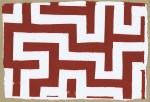
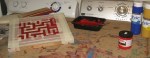
after Red Meander by Anni Albers, silkscreen on hand-laid paper by JDJ
I never got around to posting about the wonderful BMC conference in 2012, but I’m getting a head start on this one! Above is a small souvenir/artwork which I will be distributing at the 2013 event October 11-13, a project inspired by Anni Albers’ fabric art entitled “Red Meander,” and also by the book in which I encountered the image, written by Christopher Benfey. Benfey is keynote speaker at this year’s conference, which as always includes a rich array of scholarly and creative responses to the legacy and spirit of Black Mountain College,from the dissection of BMC/Bauhaus connections to the performance poetry of Ted Pope.
Benfey’s book is called Red Brick, Black Mountain, White Clay, and is a unique family memoir that ranges far and near in exploring the connections of art, craft, and history to be found in his family history and connections. Anni Albers was Benfey’s aunt, and figures largely into his take on the relationships among artisan craft, creativity, and authenticity in artistic processes. I was very impressed with his insight regarding a productive tension Benfey discerns in the threads of influence to be found at Black Mountain College – that between calm, disciplined and reflective approaches and the unfettered spontaneity made famous by the Happenings at BMC.
This year’s conference promises to cover that same range of possibilities, with presentations on archive resources, technical poetics, action painting, transcendent pottery, the BMC print shop, and multiple assessments of the importance of Anni Albers and her husband Josef Albers. Looking forward to it.
**********************
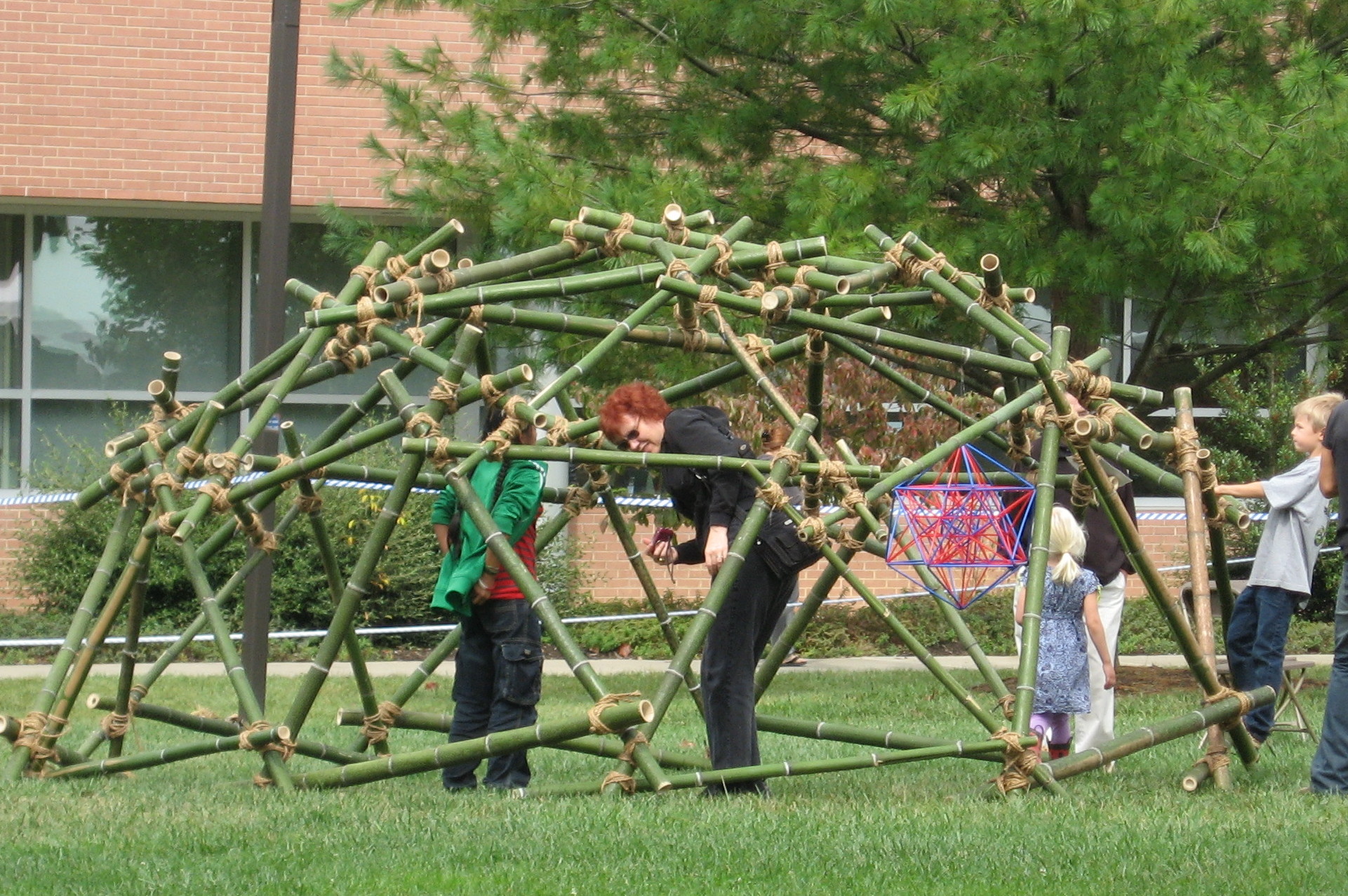
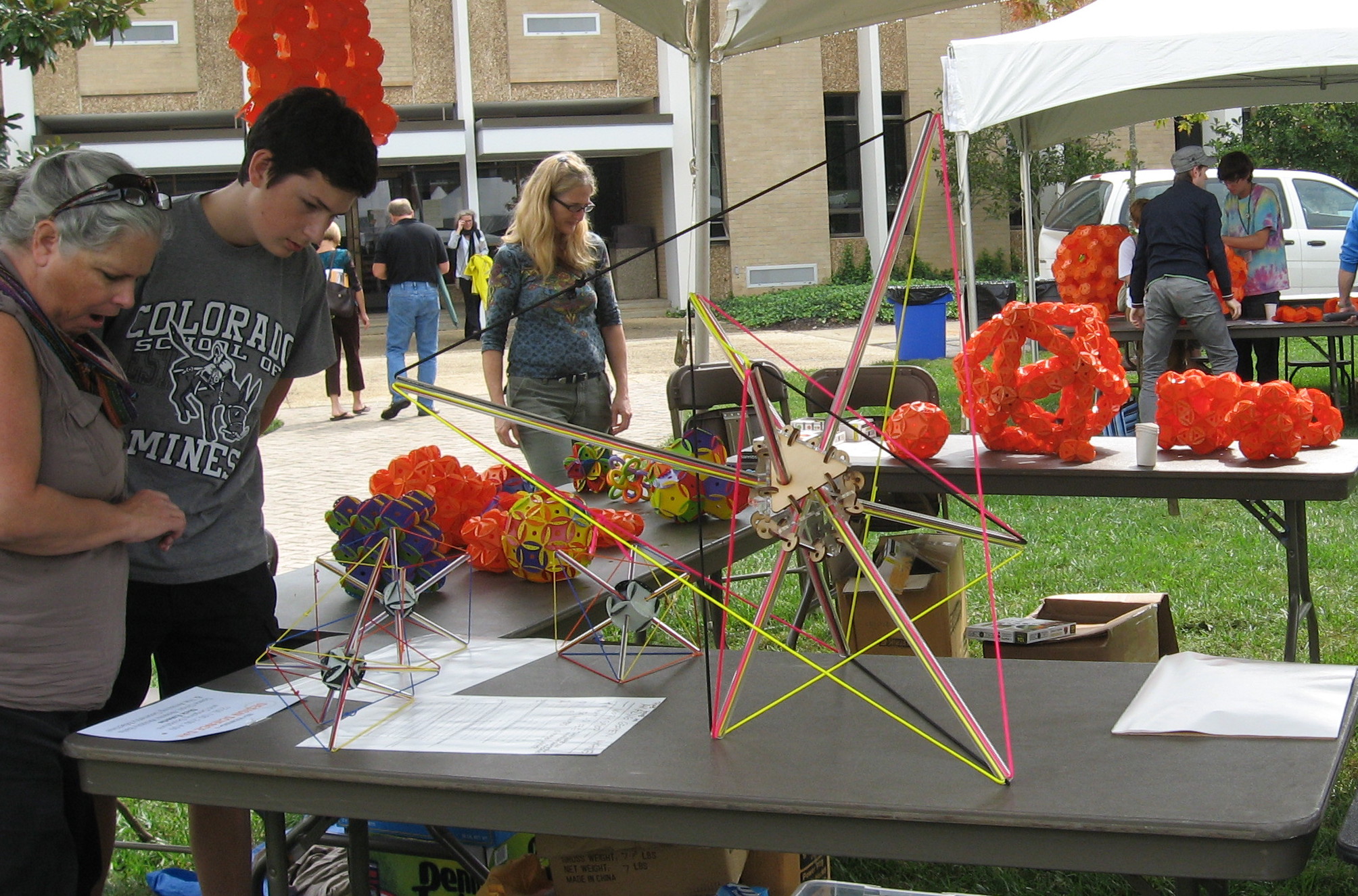
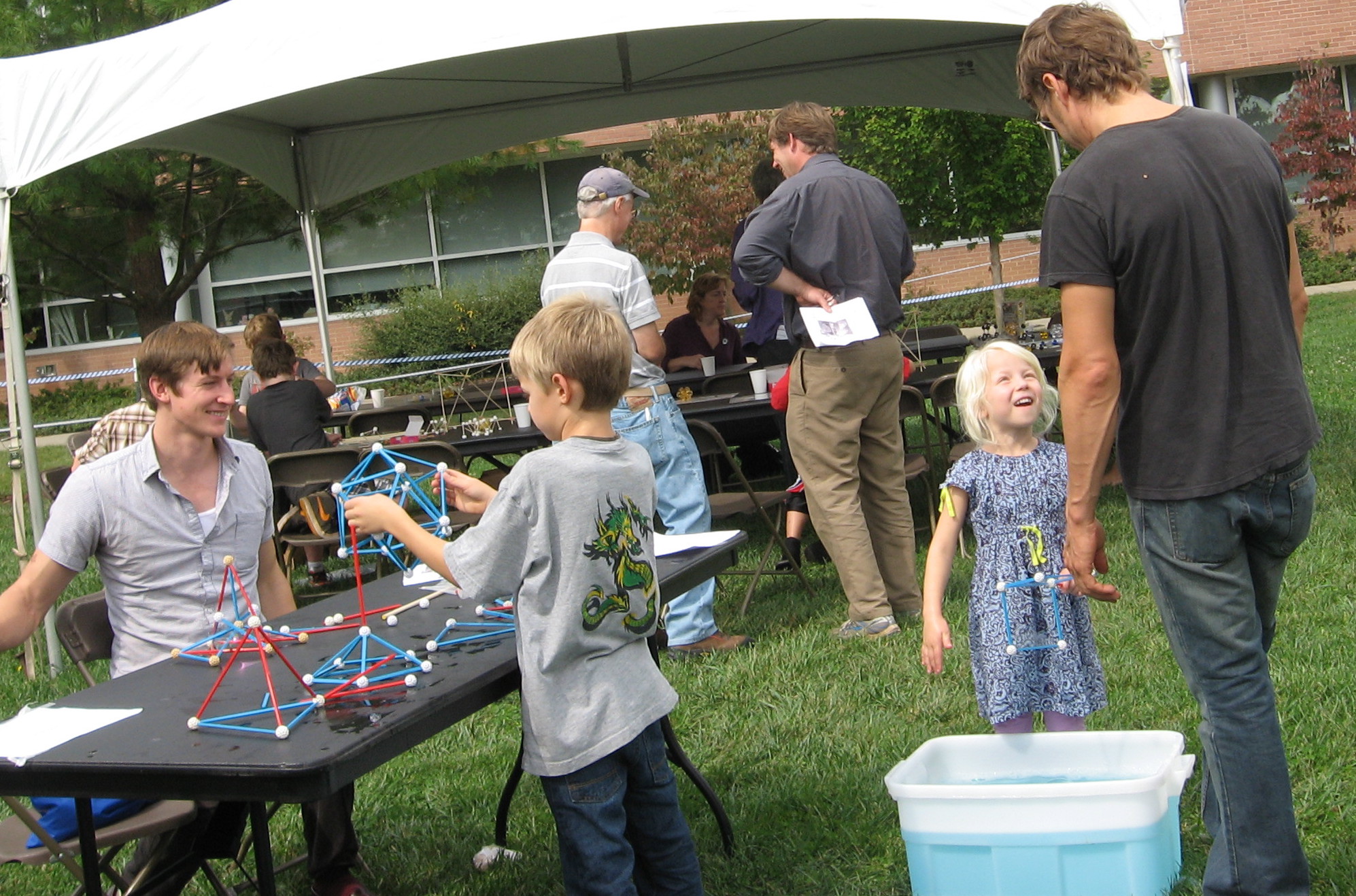
The 2012 BMC conference, held at UNC-A and organized by The Black Mountain College Museum and Art Center, centered on Buckminster fuller and the ways his ideas, many generated at BMC, have influenced our world. I would love to write about the ideas presented eventually, but above are thumbnails of a big highlight of 2012 – the outdoor technology fair that offered hands-on experiences of some of Fuller’s concepts. Click to enlarge, and be sure to check out this wonderful annual event sometime!
Bibliophile post about the making of the Meander print
Denis Wood Maps Across the World, Starting with Boylan Heights
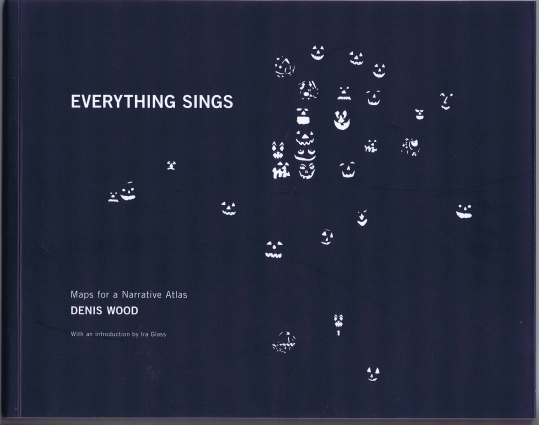
Denis Wood is an old friend who played an important role in nurturing The Paper Plant into existence in the early 1980s. He was an engaging and innovative professor during that tenure of his life, and now has turned his intellectual charms to the theory or philosophy of cartography, writing numerous books and just completing a lecture tour in Germany. His most recent publication, Everything Sings, is a book of radically different maps, illustrating his unique take on what a map can be and how it effects us. It is also a wonderfully quirky portrait of Boylan Heights, and the book’s success shows how interesting and important Denis’ work is, as well as how hot Raleigh is, and how treasured is that neighborhood in its history. The book cover, seen above, displays the location and carving pattern of Boylan Heights pumpkins on a Halloween. Pecan tree locations, utility services, and lot sizes all became subjects of innovative maps created by graduate students under Wood’s tutelage.
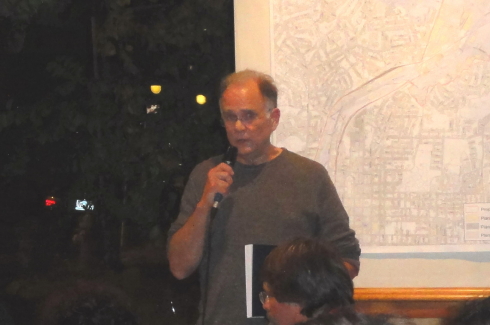
Denis spoke and presented this fall at the Boylan Ave Brewery to celebrate the publication of the book. It was well attended and Denis entertained quite well with the amazing story of how his book came to be – an interview for background information with Ira Glass for an NPR story on maps, his casual mention of a long term project with NCSU design students, and the subsequent segment of This American Life which brought the project to the attention of book publishers. The actual production of Everything Sings involved many winding turns, but now that it’s finally out, it is not only selling well, but been nominated for the University of Iowa’s The Essay Prize.
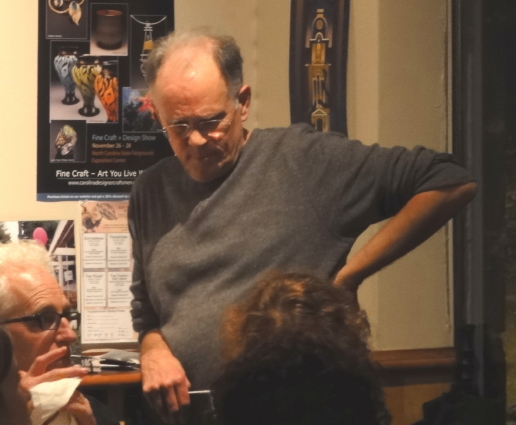
Denis is such a creative thinker and enthusiastic cultural worker. His talk presented small samples of the ideas in his major books – that maps represent not just a set of places but a representation of the way we think about places, if at all. Maps can take many forms, and the formats of our maps shape the way we think about the world. Maps can enhance, shift or corrupt our view of the world. We can also enlarge our sense of the world through creative use and creation of maps, and that is at the core of Denis Wood’s work.
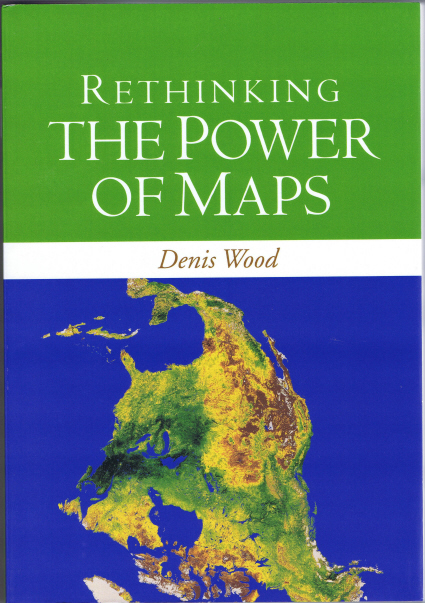
The book that helped promote and elucidate these concepts on the national scene is The Power of Maps, his 1992 book, co-authored with John Fels, that helped literally turn everyone’s concpetions of maps upside down. Last year, they published the title pictured above, which updates and enlarges their approach.
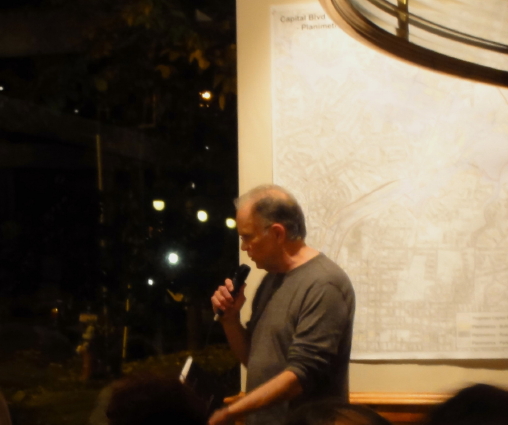
Denis is continually sharing his ideas. His recent presentation at a conference called Mapping Maps: What’s New About Neocartography, in Seigen Germany, was part of a media studies program, and involved people working at what seems to this layman to be right at the edge of cartography: Geo-annotation, The Rise of Aerial Photogrammetry, Performative Cartography, Playful Cartography, and explorations of web resources such as OpenStreetMap. Denis was the main evening speaker and presented his critique entitled The Challenge to Neocartography Posed by Guy Debord and Kevin Lynch. His workshops in Frankfort shared his ideas on the nature of maps with graduate students, and in Liepzig he presented to traditional geographers about “A Place Off the Map: The Case for a Non-Map-based Place Title.”
All this was and is very interesting but I must confess my favorite stories from Germany were about the European flavors and customs, along with some delicious gossip about European academic politics. Denis provokes you to consider new ideas, but he doesn’t press them – mainly because he’s quickly on to some other new ideas – plus the ones you’ve made him think of during the conversation! He is a treasure, he is doing great stuff, and I hope you keep an eye out for him.
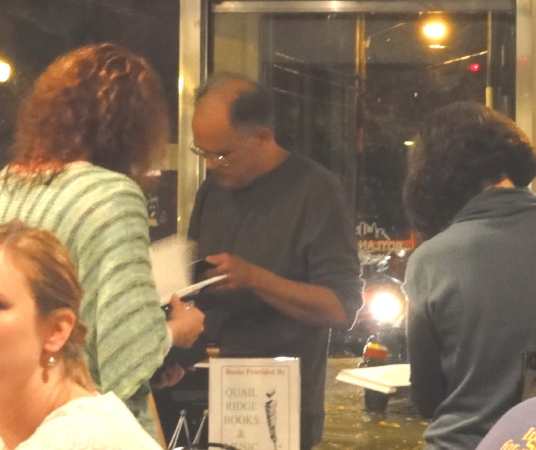
- Denis Wood signs his new book at the Boylan Ave Brewpub
Siglio Press on Everything Sings:
Denis Wood has created an atlas unlike any other. Surveying Boylan Heights, his small neighborhood in North Carolina, he subverts the traditional notions of mapmaking to discover new ways of seeing both this place in particular and the nature of place itself. Each map attunes the eye to the invisible, the overlooked, and the seemingly insignificant. From radio waves permeating the air to the location of Halloween pumpkins on porches, Wood searches for the revelatory details in what has never been mapped or may not even be mappable. In his pursuit of a “poetics of cartography,” the experience of place is primary, useless knowledge is exalted, and representation strives toward resonance. Our perception of maps and how to read them changes as we regard their beauty, marvel at their poetry, and begin to see the neighborhoods we live in anew. Everything Sings weaves a multi-layered story about one neighborhood as well as about the endeavor of truly knowing the places which we call home.
That a cartographer could set out on a mission that’s so emotional, so personal, so idiosyncratic, was news to me. IRA GLASS, host of This American Life, from his introduction to Everything Sings: Maps for a Narrative Atlas
Ira Glass interview with Denis Wood about Everything Sings:
http://www.thisamericanlife.org/radio-archives/episode/110/mapping
Denis Wood website:
http://www.deniswood.net/home.htm
This book is featured on Places, the online journal of architecture, landscape and urbanism
http://places.designobserver.com/feature/everything-sings-maps-for-a-narrative-atlas/30358/
Ray Johnson: Tracking Deep Currents
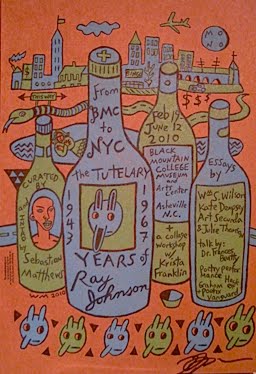
The Ray Johnson show at the Black Mountain College Museum in Asheville opened February 19th and will run through June 12, 2010. The opening was spectacular, the show is rich, varied and informative. For Ray J fans like me, the catalogue and it’s essays, assembled by show curator Sebastian Matthews, is the real treasure. Sebastian spent over a year studying Ray’s life and work, making connections with important people in Ray’s life (Ray passed in an act of suicide in 1995), and establishing his own perspective on the evolution of Ray’s art from a young art student in Detroit through a strong experience at Black Mountain College to an important role in the art scene of East Village in the 60’s and 70’s. The show displays extensive early work, including fairly typical ink doodles of 14 year old Ray, but also hilarious cards and visual puns from this period that presage his later work.
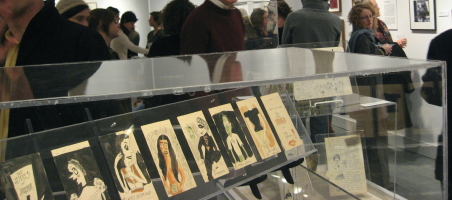
The show also reveals the aspect of Ray’s work I most needed to learn myself – that Ray came of age as an artist in the painterly traditions BMC and Josef Albers provided, and did lots of wonderful work as he evolved from painting to collage and then on to the correspondence work or “postal performances,” as Isa Bloom calls them, which made him most famous. The show focuses on Ray’s emergence out of Black Mountain College into the New York scene immersed in the ideas of his BMC mentors but prepared to follow Alber’s dictum: “to follow me, follow yourself.” As Sebastian Matthews says in his catalogue essay, “Ray was ripe for the challenges and experiences Manhattan had to offer.” He became one of the most intriguing and complex artists of the 20th century, and this show delineates many of the roots and threads that set him on his path.
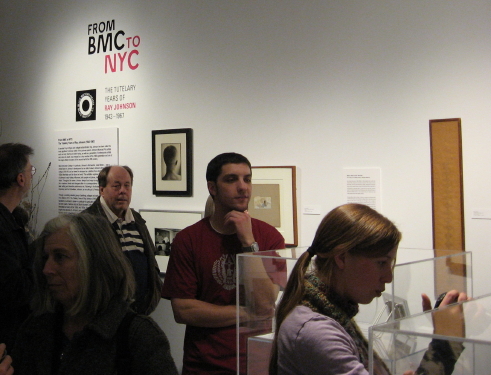
The opening of the show was well attended and featured some aspects Ray might have liked very much, though he generally was quite ambivalent about exhibiting or selling or even saving his work. Poetix Vanguard offered spoken word performances during the event, and an open mike followed at a bar nearby. The BMCM+AC library, with many Ray J items prominent, provided a nice context for the highly varied show. Several of Hazel Larsen Archer’s gorgeous photos of Ray at BMC were on display. And Sebastian Matthews, collage artist himself and so clearly a Really Great Guy, presided with enthusiasm over the many energies he had gathered to celebrate the amazing career of Ray Johnson.
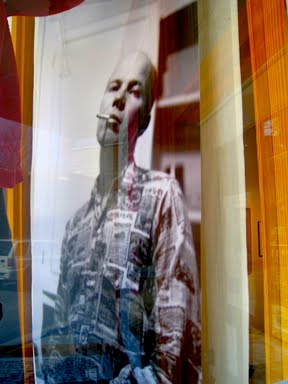
Ray J show window display at BMCM+AC
The catalogue contains 46 color plates, over a dozen images in the text, and several of Archer’s photographs. It also contains an interactive feature: a pair of postcards bound in as endpapers which the reader is invited to alter as desired and send off: one to a friend and one back to The Black Mountain Museum and Arts Center, whose program director Alice Sebrell is credited by Sebastian as being integral and vital to the process of creating the show. Five essays offer views of Ray that are remarkably varied and complementary.
Sebastian Matthews presents his curatorial essay as nine journal notes written while building the show. He elaborates his basic point: that Ray Johnson “used Black Mountain College as a springboard to propell himself into the Manhattan art world.” He also does a remarkable job, with his intense self-examinations, numerous concrete biographical insights, and constant awareness of Ray’s own probable intent to be inscrutable, of helping us have a “fuller sense of what Ray attempts when he sits down to make art, when he prepares to send out the work to be received, passed on, altered.” The quote is what Sebastian hopes to accomplish with the show, and I think he got there. He also truly transformed my personal sense of Ray J by portraying the intense, painterly, quite technical control Ray exerted over his collage work.
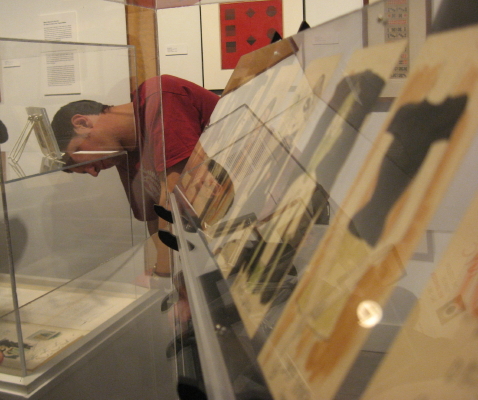
Ray Johnson’s career had many layers, and two essays by old friends of Ray offer insight into his early days in Detroit and his heyday in the East Village. Arthur Secunda contributed much material for the show and portrays in his recollection “Ray Johnson’s intelligence, mysterious youthful verve and artistic ingenuity.” William S. Wilson, the primary lender of the collage works, and one of Ray’s long-time art buddies, makes his essay a tour de force in Ray J style quirkiness and abrupt juxtapositions. He says “Ray Johnson was a student of the imaginations of other people.” He ably describes Ray’s focus not on abstract ideas but direct concrete responses, because Ray “worked to remain within immanences, eluding transcendentals.”
Two academic writers share their ideas about the inportance and significance of Ray’s work. Julie J. Thomson thoroughly documents the large and lasting influence Josef Albers had on Ray’s work. She also describes the way Ray’s work related to the “Happenings” and other art trends of the times. Kate Erin Dempsey, in “Code Word:Ray,” shared a long excerpt from her work in progress about Ray and his reaction to and use of the fad for secret codes and hidden messages raging in the 1950s. Expanding on the fascinating work she shared at the BMC conference, she convincingly demonstrates Ray’s fascination with language and its manipulation for artistic purposes. Furthermore, she follows this thread from radio show decoder rings through the Mayan hieroglyphics and glyphs revered at BMC, to Ray’s mature use of found images – giving them a “new lease on life – enhancing or altering their meaning entirely by arranging them in novel ways.” Kate’s work at the BMC conference, this essay, and hopefully her future book will all warrant future Ray J posts.
The kernel I found that connected all these essay? Nothings – empty shells of meaning – e.g. nonsense – that serve as markers and triggers for the kind of nonlinear art experience Ray Johnson wanted you to have. William S. Wilson talks of “the surface concealed only by another surface.” Julie J. Thomson finds their roots in “the gap, an element emphasized by Albers in his teaching,” and makes the valid and often repeated connection between Ray’s study of Taoism and these ideas. Kate Dempsey makes it clear Ray wanted to avoid specific meanings, sending messages in bottles to be partly constructed by the finder. Sebastian reminds us that Ray was “an autodidact student of Buddhism and a self-described disciple of John Cage’s cultivation of chance occurrence. ” Julie Thomson describes the performances Ray created entitled “Nothings:” they “interrupted the Happenings, opening up a space amidst the busy environments and experiences of the Happenings.” Ray brought Zen and his unique fusion of life and art into American art, and made his mark with great gifts and energy.
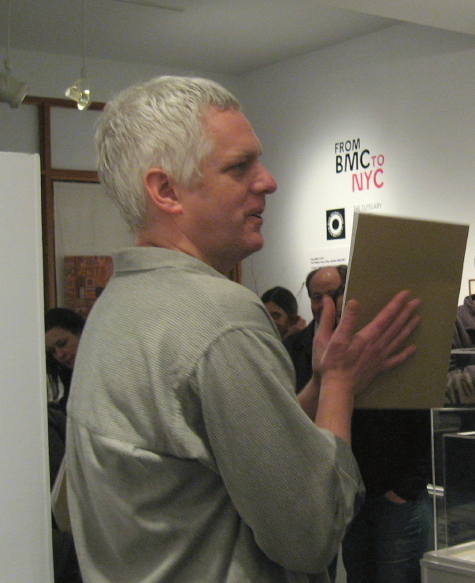
Sebastian Matthews, curator of the Ray Johnson show
Sebastian Matthews has provided an amazing set of Ray Johnson experiences to me , starting with the BMC conference, many kind and enthusiastic interactions, and now this multiple-event, long-running show. He did all the myriad tasks and jumped through all the hoops to make this show happen, but he clearly handled the situation as a working artist and remained beautifully true to the spirit of Ray Johnson with everything he did as a result. See this show and then follow Sebastian’s advice:
Don’t get too caught up in finding meaning in every little detail. You need to first catch a drift of the mood and follow it back in. Let the work show you how to see. Let Ray work his magic. Sebastian Matthews, from BMC to NYC
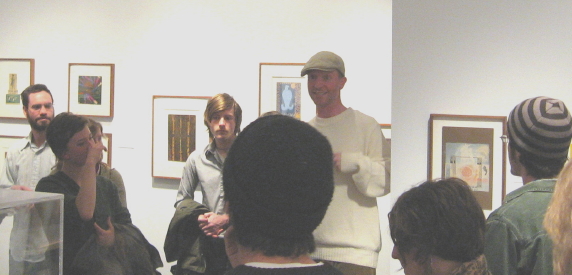
Graham of Poetix Vanguard offers spoken word to the Ray J crowd
The event was a blast and was just the beginning. Remember the show runs til June 12th, and there are lots of special events to help motivate the trip. A collage workshop by Krista Franklin had occurred by this post, a screening of How to Draw a Bunny, an award-winning Ray J documentary will take place on April 8, and Dr. Francis F. L. Beatty, a curator who works with the Ray Johnson Estate, will speak about Ray’s work on May 21. The show will celebrate its closing with a poetry reading on June 12th. The Black Mountain College Museum and Art Center, sponsor of all events, has just announced a fascinating weekend event at the old dining hall building on the BMC campus. Sounds fun! BMC lives!!
Black Mountain College Conference
The greatest thing a human soul ever does in this world is to see something and tell what it saw plainly. John Ruskin
The conference held in Asheville October 9-11 about Black Mountain College and its legacy was a stunning success. A myriad of diverse presenters joined with performers, poets and artists to celebrate the influence of the college and the accomplishments of its alumni, both teachers and students. A collaboration of The Black Mountain College Museum + Art Center and UNC-Asheville, the conference was a long-awaited gathering of energies from across the country and beyond, searching for the memory and meaning of Black Mountain College.

BMC existed just 24 years, from 1933 to 1957, but this conference made clear that its radical vision of education and incredible nexus of creative individuals resonates deeply in our arts and culture. There were so many threads of research and inquiry presented, I can only speak of my own journey through the presentations. Planning to focus on Ray Johnson, I found myself captured by powerful ideas about the basic philosophy and significance of BMC, and intrigued by new perspectives on the creative processes which emerged there.
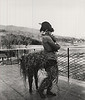
Initially, students at BMC were required to take only 2 courses: philosophy from John Andrew Rice and art from Josef Albers. Rice’s philosophy, informed by John Dewey, created a new mode of education at BMC, one that featured the internal discipline generated by students doing as much as absorbing. Michael Kelly’s presentation on Dewey in relation to BMC brought out the powerfully humanistic nature of liberal arts education as conducted at BMC. With art central to his view of experience, Rice designed the curriculum to elevate the quality of experience in students until they were prepared to be democratic citizens. Seymour Simmons helped connect the educational philosophy to the artistic act with this wonderful description of the act: “an inventive response to genuine problems involving collaboration and conflict while engaging and integrating multiple human capacities.” Josef Albers wanted for his students no more or less than a new mode of seeing, and his manifest genius was the nugget of magnetism that drew such stellar powers to the place.
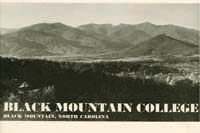
The place! Over and over the theme of place ran through the conference. Black Mountain was a unique haven of sorts, and a bivouac as well for the sorties against New Criticism and the strictures of Modernism. It was literally a quiet spot in the harried life of urban artists and teachers who came. Yet there were privations, great stress, and no assurance of the fame and influence we look back on today. Two living Black Mountain figures, Dorothea Rockburne and Michael Rumaker, presented at the conference and helped establish the sense of the place.

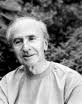
I found the presence of two deceased BMC figures, M.C. Richards and Ray Johnson, to be very strong due to the passionate work being done on them by current young scholars. M.C. Richards embodied the highest principles of the Dewey aesthetic in seeing and living the connnection between art and life. Jenni Sorkin of Yale University described Richard’s costly rejection of a conventional academic career for the esoteric but rewarding concepts of Rudolph Steiner and Matthew Fox, the “Centering” of being required for art in clay,and the attempt to practice the apprenticeships of art to prepare for “the big art… our life.” Kate Dempsey and Sebastian Matthews both offered invigorating interpretive perspectives on Ray Johnson, and convinced me once and for all that Ray is the epitome of Black Mountain students, and carried into the world a fundamental store of post-modern concepts gained at Black Mountain.

More than one speaker described the roots of post-modern thought to be discerned in the Black Mountain canon. Andrea Lui from NYC named three: 1) knowledge as contingent and partial, 2) photography as art, and 3) promiscious mixing of disciplines. The relation between and hierarchy of the disciplines at BMC provided some interesting contention among the scholars. Speaking of the interdisciplinary approach, Louly Peacock Konz offered perhaps the most purely entertaining talk of all with her description of the play “The Ruse of Medusa,” translated from Satie’s French by M.C. Richards, and performed by Buckminster Fuller as the baron and Merce Cunningham as the “costly mechanical monkey,” among others. Black Mountain College established a perceived “school” of poetry, encompassing authors who never set foot on the campus. Rachel Stella from Paris described the Black Mountain Review as the base for a “textual community” which helped transform the structure of literary publishing of the era. Charles Olson’s massive literary influence came up again and again, with Jonas Williams of SUNY-Albany reminding us that Olson said: “art does not describe, but enacts.” Forming, transforming, teaching by action, seeking the transcendent in the material: these were the forces that coursed through education at Black Mountain. Over several near-future posts, I will recount some of the amazing insights shared at this conference, especially my greatly enlarged perspective on Ray J. The central role of experience in learning and the intellectual freedom derived from Socratic and democratic principles were key elements in Black Mountain’s existence and lasting influence. From this cauldron of intellectual striving and artistic practice emerged various and wonderful creative expressions with much to tell us today. This conference did not dissect a historical movement, but uncovered living roots of a vital cultural force that sends wick green shoots upward as we speak.
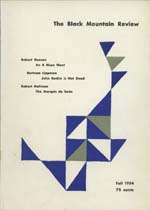
We must carry in our souls a picture of creating little by little
the vessel of our humanity. M.C. Richards
raleighrambles.com
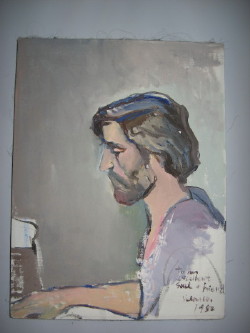
portrait by Guillermo Velasco


 Raleigh Rambles