Bain Music and Media
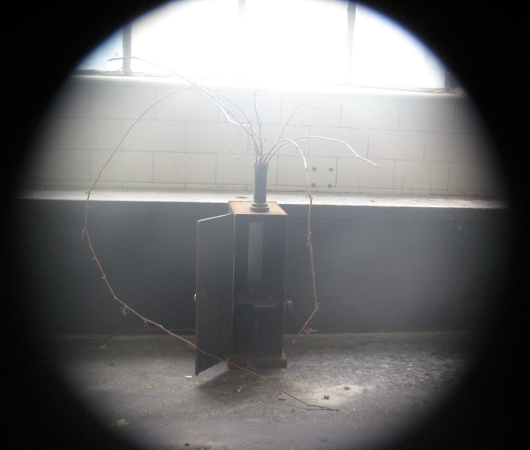
The Bain Project has garnered its fair share of attention and brought together an amazing array of artistic and journalistic support. It also crossed and melded artistic media in an extraordinary fashion. The installation itself captured sights, sounds, smells and memories in a unique way, and a fitting emblem of this is the Bain Music Project cd, which will certainly stand the test of time as a valuable record of the Bain Project experience and a fascinating album of boundary-pushing music in its own right.
The cd offers short interview excerpts with a former Bain employee, mixed with cuts of local bands recording inside the Bain space. The remaining pieces constitute primary Bain Project work by Lee Moore, whose maternal condition precluded extensive on-site participation. Lee and her husband (and longtime musical partner) David Crawford put together some amazing sets of sounds as Le Machine, and also did me the great honor of building cut # 12 with an old water-based poem of mine. I recorded it with Jen Coon, and then Lee put it over ocean sounds and her newborn baby’s heartbeat! I could never have dreamed that a piece of my writing would have such a stunning setting. Thank you Lee.
I enjoy every track of the cd, especially Crowmeat Bob’s highly Bain-ful sounds and Xopher Thurston’s string interpretation of Dana Raymond’s pipe symphonies, but am totally un-equipped to remark on the local popular music. I just know my 20 year old daughter was thrilled to see me on the same album as the Rosebuds! I also know that the cd cover is masterful and fits so well with the project, thanks to Ladye Jane of New Raleigh fame. New Raleigh published the cd, and was a tremendous support to the Bain Project overall, including provision of the Bain website.
Starting from the website, let’s trace the main branchings of media and online response to the project.
NPR
May 09 “State of Things” interview with Dana Raymond, Marty Baird Sarah Powers and JenCoon
SpokenWord.org archived radio link
New Raleigh
Volunteer call hosted by New Raleigh
January 09 Missing Plaque Mystery
February 09 Music Fundraiser
March 09 David Millsaps essay
May 09 Ladye Jane’s Q & A
May 09 State of Things alert with links to Sarah and Dana
May 09 Toxic Lead Alert with Bain concerns
Independent Weekly
March 09 Music Fundraiser guide
April 09 Indie Blog article
May 09 Calendar listing
May 09 Site and project description by Hobert Thompson
May 09 Indie blog Q & A with organizer Daniel Kelly and others
NandO
May 09 Art to suit city’s fluid identity
NC Museum of Art
May 09 blog interview with Museum staffers Jen Coon & Stacey Kirby
NCSU
DESIGNlife news with listing of the numerous alumni involved
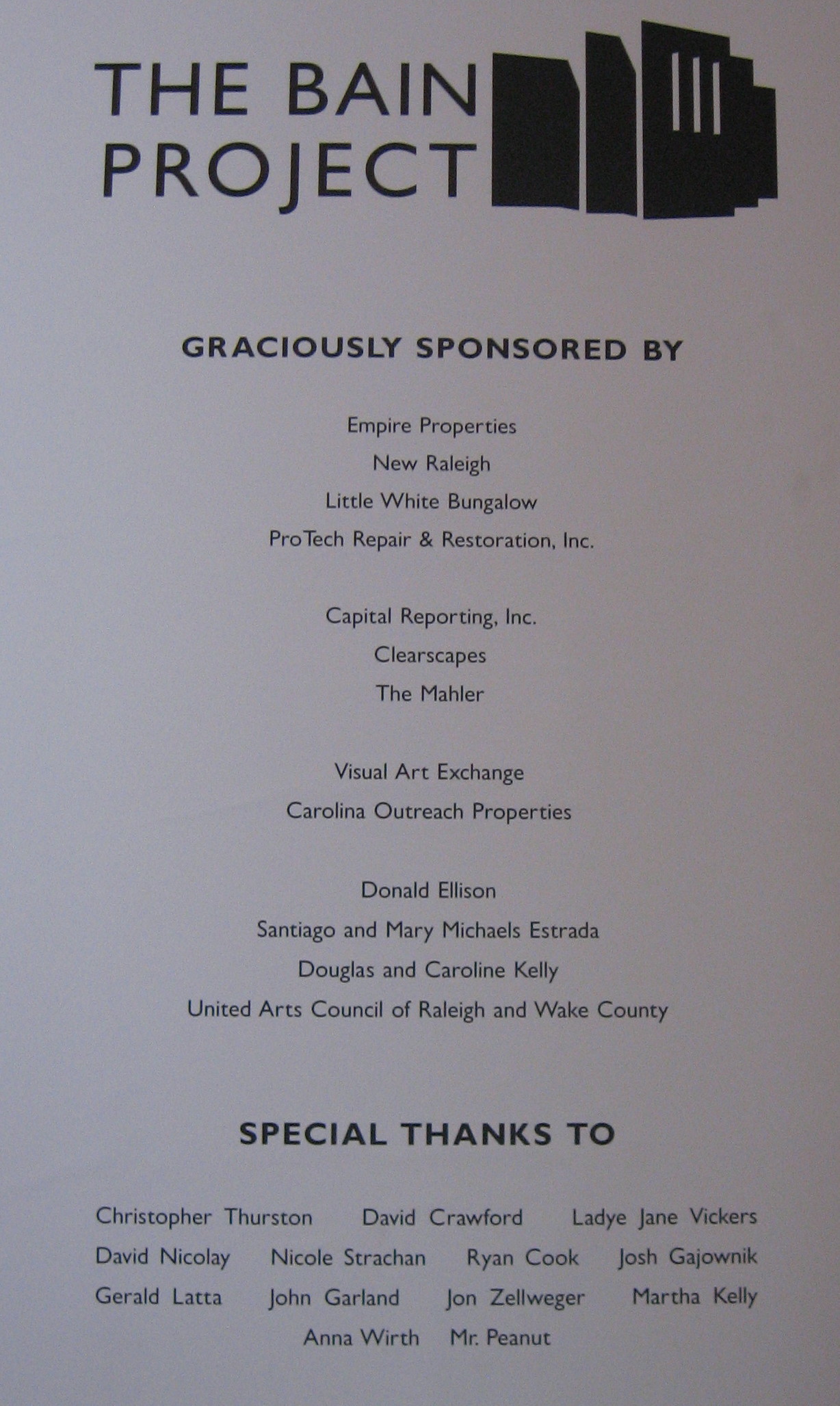
Bain credits
Blog Reactions
30 Threads feature
Raleighwood,NC John & Clydes visit with informative links
Queen of the Pavement – huge and lovely pics
Digital Photo Project with another, and one more – nice photos and text by Kevin Greene
almost two weeks – wonderful blend of Bain and life
a weed is just a flower out of place – just one nice photo but who can resists that title?
Bain poster critique – proof post-Boomers do not read 🙂 actually a nice post
not to mention
youtube Triangle Rock excerpt
353 Flickr results
Mike Legeros’ Firefighting blog listing
The following excerpt from an email sent out by SWCAC Chair Mary Bell Pate for the Caraleigh neighborhood.
The Bain Project, located in the SW CAC area, is all about the E. B. Bain Waterworks/Water Plant that once was the source of water for Raleigh and now is on the Historic Register. What was a beautiful Art Deco building had been ignored since it was “de-commissioned” as our water plant and now needs massive amounts of money for restoration. Empire Properties came to the rescue by buying the Bain and saving it from total destruction. Within the next few years a street will connect South Wilmington and South Saunders Streets (needed for years as an efficient cross-access between the two streets) and will go right by the Bain.
With lots of help from many people the Bain Project will become another outstanding asset for Raleigh and especially for our southwest part of Raleigh. Right now it needs your interest and participation in events designed to create awareness of this beautiful, old building opposite the Eliza Pool Park. From time to time I will be giving updates on Bain Project activities and encouraging your participation.
and last but not least
National Park Service Bain site page
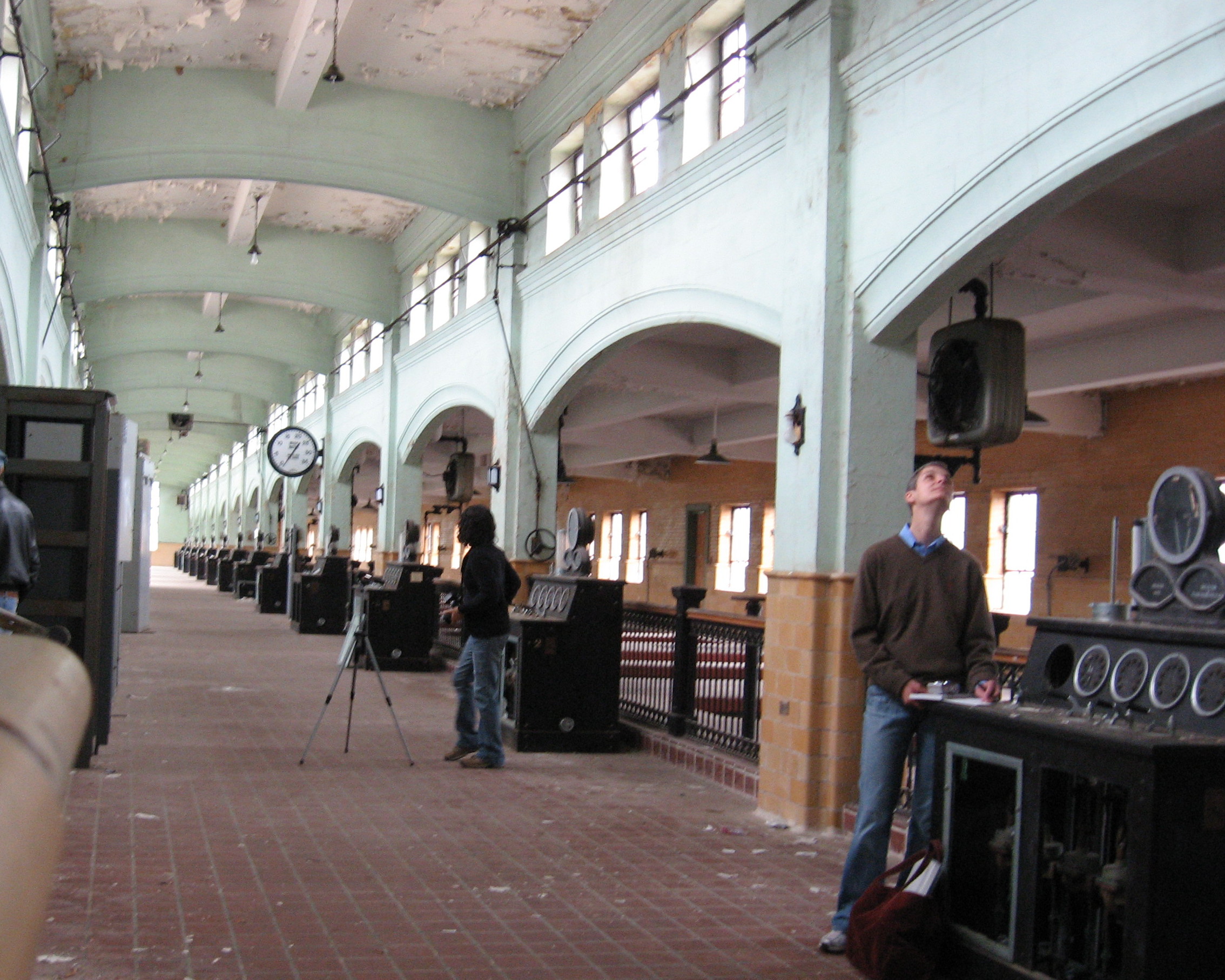
Artists survey pre-installation site
If you’ve made it this far I’ll remind you that here at Raleigh Rambles ALL my work to document and preserve the Bain Project is organized and referenced on my Bain Page. The list above grew out of a reference post on the Bain Project website, which has obviously been a rock for me in this project. We can all thank Daniel Kelly for conceiving of and effecting this project, and I personally appreciated his encouragement as I participated in and documented the project.

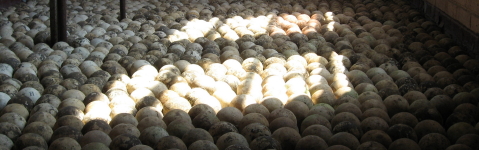
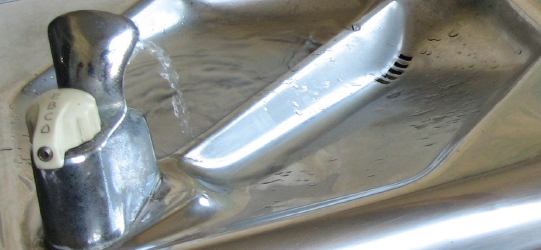
Raleigh Public Record posits new journalism model
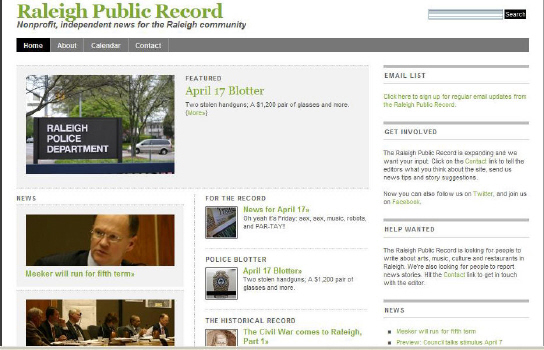
The Raleigh Public Record is a new website dedicated to “nonprofit, independent news for the Raleigh community.” They recently held a fundraiser at the 101 Lounge, and between the speaker’s remarks and my conversations, I learned some quite disheartening news: The News and Observer is conducting yet another round of cuts/buyouts that include a core group of reporters and editors, whose removal more than any others yet announced, signals the beginning of the end for our fine local newspaper.
The Raleigh Public Record is preparing to step into that emerging gap with a new model of journalism that includes cutting edge presentation of public records, in-depth treatment of local topics, and a business model that provides maximum editorial freedom. Charles Pardo, founding editor, is looking for some high ground between the old and fast-eroding bastions of print news and the proliferation of admirable but highly uneven and unpredictable local blogs. The largest of these is prone to slipping into pop culture and advertiser-driven topics – nothing wrong with that, but it’s not quite community service journalism. And the most beloved local blog makes no pretense of presenting anything other than exactly what they feel like – or have photographed the night before! The Raleigh Public Record wants to use the blog forum to develop a juried and professional venue for high quality news. Their fundraiser attracted a strong showing of journalists and intelligentsia, well described at yet another new local blog. The site has changed significantly over its short life and will continue to evolve as it develops tools and sources for a new paradigm in local news.
Back to NandO, which has served this community so well for so long. The list of reporters leaving this week – Wade Rawlins, Ned Barnett, Joe Miller, Jon Peder Zane, and others – represents not trimming fat, nor even amputating trapped limbs, but cutting out heart muscle. Or, as a speaker at the RPR fund-raiser put it: ” The News and Observer has attempted to maintain height in a sinking plane by tossing out the engine – a strategy that will work for just a few seconds.” Doubtless the publishers will say that their younger (i.e. less expensive) reporters will pick up the slack, and they will say that their migration to an online model is going well. We must also remember that NandO is a fairly healthy paper – it is the financial woes of McClatchy, its parent company, that is creating most of the stress. But it seems clear that, in the end, McClatchy will suck the life out or our local newspaper and then sell it off to die a slow death.
In the wake of that tragedy, we will need new models for how to share and come together as a community about the issues of the day. The Raleigh Public Record is a good start, and it is a fascinating experiment in new models of journalism. It deserves our support – check it out!
And as a final disclaimer in this highly personal blog setting, I am thrilled to be part of the Raleigh Public Record with a column called The Natural View.
The Natural View
Farm to Market – Raleigh Locavore Pathways»
John Dancy-Jones is beginning an occasional column on Raleigh nature and the environment.
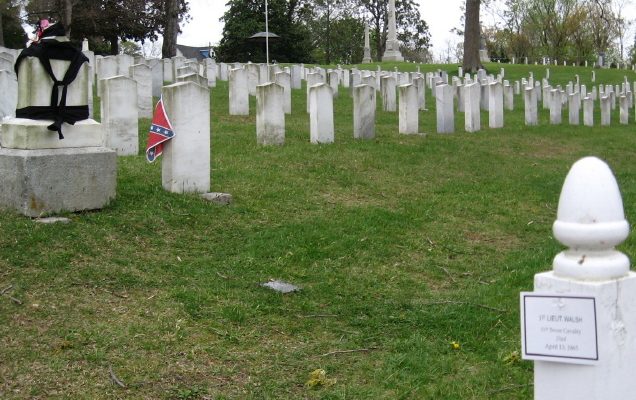
Lt. Walsh Remembrance Reaches 20 Years
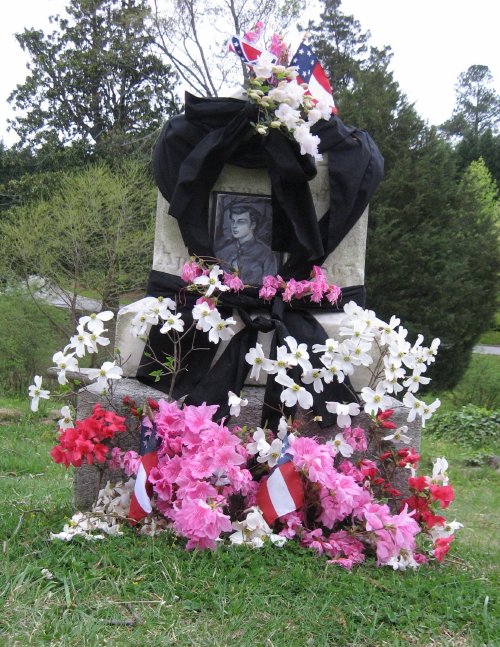
Lt Walsh decoration April 13, 2009
A year ago, in starting this blog, I made use of a personal connection and had a little fun with the mystique surrounding the annual decoration of Confederate Lt Walsh’s grave in Oakwood Cemetery. Just as last year, Channel 5 treated it like a mystery, and for the 20th year, an old friend managed to make his remembrance, hold an afternoon reading, and retire to a well-earned evening of mint juleps with friends unscathed by identification. I missed the reading this year, vacationing in Charleston with Cara, but our experiences there had me well steeped in Confederate lore as I checked by the gravesite and stopped for a quick visit at the post-reading party. I’m quite sure they’re still sitting around in Oakdale as I write this, so the event is in process, but Good Night, Raleigh got out an uncannily timely post about the decorations and directs us to NandO’s contribution to last year’s media coverage ( WRAL had current footage of this year’s decorations joined with a re-run of last year’s story). As I promised a year ago, below is the contemporary account included in the printed handouts that accompany the remembrance/celebration.
The Incident at Lovejoy’s Grove
As witnessed and related by Millie Henry
“I was drawin’ water at th’ well at th’ end of Fayetteville Street when th’ Yankees come. I seen ’em ridin’ up th’ street with their blue coats shinin’ and their horses steppin’ high. I knowed that I ought to be scared, but I ain’t; an’ so I stands there an’ watches.
“Suddenly, as they passes th’ bank, out rides two men from Wheeler’s cavalary, and they gets in the middle o’ the street; one of th’ horses wheels back an’ th’ man shot right at th’ Yankees, then he flew from there.
“Two of the Yankees retracts from th’ army an’ they flies after th’ Rebs. When th’ Rebs get to th’ Capitol one of them flies down Morgan Street an’ one goes out Hillsboro Street with th’ Yankees hot in behind him.
“They catched him out there at th’ Hillsboro [Street] bridge when his horse, what was already tired, stumbles an’ he falls an’ hurts his leg.
“Durin’ that time th’ big man with th’ red hair what they calls Kilpatrick brung up his men to th’ square an’ sets under th’ trees an’ a gang o’ people comes up.
“When they brung th’ young good lookin’Reb up to th’ redheaded Gen’l, he sez: ‘What you name, Reb?”
“Th’ boy sez: Robert Walsh, suh.’
“‘What for did you done go an’ shoot at my army?’
“‘Cause I hates th’ Yankees an’ I wish that they was dead in a pile!’ th’ Reb sez, an’ laughs.
“Th’ Gen’l done got his dander up now, an’ he yells: ‘Carry th’ Reb somewheres outta sight o’ th’ ladies an’ hang ’em!’
“Th’ Reb laughs an’ sez: ‘Kind o’ you, suh!’ an’ he waves goodbye to th’ crowd, an’ they carried him off a-laughin’ fit to kill!
“They hanged him on a ole oak tree in th’ Lovejoy Grove, where th’ Governor’s mansion stand now, an’ they buried him under th’ tree.
“Way after th’ war they moved his skeleton to Oakwood Cemetery an’ put him up a monument. His grave was covered with flowers; an’ th’ young ladies cry.
“He died brave, tho’, an’ he kept a-laughin’ til his neck broke. I was there an’ I seen it; furthermore, there was a gang o’ white ladies there, so they might as well a hanged him on the capitol square.”
Millie was a ten year old servant in the Boylan family household who in 1865 was employed at a Fayetteville St. boarding house.
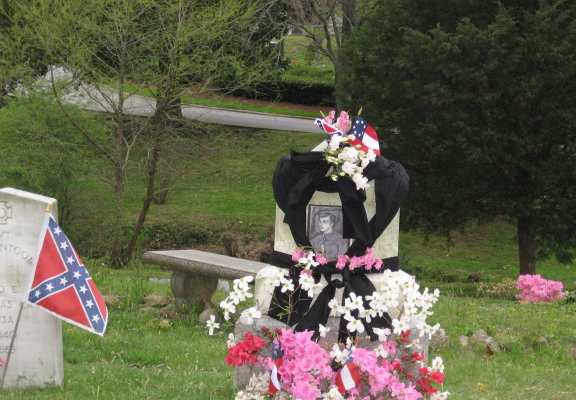
I concur with Goodnight, Raleigh in saying thanks to the local history lover who keeps this fascinating story alive in our hearts and memories.
A Zane Game-Changing View of the Future

Jon Peder Zane is one of numerous dedicated, serious folks who are working to keep good reporting and good writing alive at the News and Observer. He was the book editor until the drastic changes under McClatchy’s management turned him into the Ideas Reporter, and I have actually very much enjoyed the products of his new beat. He has written about everything from banned Christmas trees to bioethics. He has also consented to create a series of videos for NandO’s website – Fist Bumping is typical. ( He really turns being stiff into a comic artform). But this guy’s writing is just downright stimulating! His book, The Top Ten: Writers Pick Their Favorite Books, has gotten a great, well-deserved response, and his 1999 Distinguished Writing Award proves he has been doing great work before and through all the changes at NandO.
J Peder Zane: Science visions, dark and bright
He has outdone himself, in my mind, with his response, this year and several previous years, to the Edge annual big question. These highly provocative writings cast a huge net in searching for the meaning of our times. In the essay linked above, he sees hope in the prospect of vastly improved bodies, and justified fear in the idea of transmitted neural signals. He ends with the hope that science will continue to be of overall benefit, as in the past. Zane focuses on issues about which he has written before – stem cells and genomics. But he gave a sense of the wide ranging ideas contained in the series, and I went and downloaded and printed them. I will be processing what I read for a long time, but I will offer the notes below, with thanks to Jon Peder Zane for the motivation and stimulus!
***************
Edge World Question Center 2009
What will change everything?
I love SF, and these essays skirted SF with regularity, while offering very real solutions for some pretty big problems – like death, endless energy, and radical transparency in the marketplace. The most sinister visions by far concern our growing ability to monitor and “tinker with” the mental experiences generated by the brain. Helen Fisher, an anthropologist from Rutgers, thinks Vance Packard’s “Hidden Persuaders” will take chemical and totally effective form. But we alter our consciousness with drugs and media all the time, and I think we’re more resilient than that.
The most practical visions derived from nanotechnology, with the idea that developing molecular, self-directing machinery would make materials goods as “free” as information is already fast becoming. An intermediate step in this process is suggested by both Chris Andersen and David G Myers: universal computers and all that implies.
The truly revolutionary nature of information technology is overshadowed by hyperbole about it. Kevin Kelly of “Wired” envisions a conscious intelligence arising from the Web – a “ubiquitous AI embedded in the feedback loops” of cyber civilization. Kevin Sloan, a “digital technologist,” predicts the accretion of a universal memory. As I read through the numerous essays that predicted the reality of artifical intelligence, I was always disappointed by the clear fallacies in the various positions, and comforted by the divining rod of clarity I received so many years ago from Coleridge. Clarity, that is, as to the certain uncertainty in defining the creative element that informs and energizes the human mind. They can map every darn neuron and correlate every one with a function, but that still won’t give them what they need to build a true thinking machine. Coleridge described it as a balance of “Fancy” and Reason – later Chomsky used the very methods of rational science to prove the uncatchable infinity that is human expression. Art represents a conscious presentation of creative forces that inform every aspect of human culture. That element will always be missing from artificial intelligence. Not that it’s missing from true science – which is the making of new knowledge. Timothy Taylor, an archeologist, points out the creativity generated in the “tension… between fixity and change” – science, in his view, being the major source of change. Science gives us our material culture, art attempts to re-present and name the meaning of that culture. The latter, for Taylor, is attempting fixity, but I think that’s true only for the linguistic scientist, not the poet and artist. Good art gropes to name and describe the changes, and thus makes in actuality a “new thing.”
The basic point is made by several writers in the series. Celebrating our “new” awareness of rationality’s limits, Randolph Nesse from the University of Michigan sees good science “recognizing that the body is not a machine.” Stuart Kaufman, a proponent of the value of “biocomplexity,” simply states: “the universe is open, neither fully lawful nor random.” Every artist, aware or not, assumes a non-linear infinitude of possibilities in order to work. These essays have taught me that scientist working in many fields have so much reason to feel the same. Closing with the words of Mr Nesse: “Some evolved systems may be indescribably complex.” For me, a comforting thought.
***********
Postscript
From the future to the past, J Peder Zane just wrote a couple of pieces for NandO that take a hard look at Southern culture. First he really stuck his Yankee neck out with a call for destruction of the Confederate memorial on Capitol Square. Several people were really ready to chop down on that neck! Today’s Sunday edition brings a look at Southern comic caricatures and what they say about the South. Keep up the good work, Mr. Zane! We natives need all the intellectual prodding we can get!
raleighrambles.com
portrait by Guillermo Velasco


 Raleigh Rambles