Black Mountain College Continues to Inspire, Fascinate
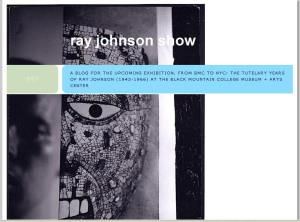
Black Mountain College and BMC+AC, the Asheville museum and art center devoted to its memory and influence, continue to generate artistic and literary responses that reverberate with the powerful cultural forces that coursed through the college until 1957. An upcoming show at the Asheville center will feature Ray Johnson, whose personal correspondence with me is described on my Black Mountain page. I am looking forward to attending and writing about the show, whose curator, Sebastian Matthews, was so welcoming and enthusiastic at the recent BMC conference. He started a blog just for this show and it’s full of wonderful Ray J images and stories. Much more about Ray Johnson before and after the show in February.
From BMC to NYC: The Tutelary Years of Ray Johnson (1943-1966)
*************

Jonathan Williams feature by Jeffery Beam and Richard Owens
Jeffery Beam, UNC botanical librarian and Hillsborough poet, has made a major contribution to Black Mountain documentation with his recently posted Jonathan Williams archive, which gathers a wide selection of photography, poetry and essays in order to capture the unique vision of Jonathan Williams. Jeffery and Richard describe the scope of the project below.
The work he produced for more than half a century is such that no one activity or identity takes primacy over any other. He is never only a poet or photographer, an essayist or publisher. What we find instead in the figure of Williams is a continuity that cuts across these practices — something we might call a poetics of gathering. All of his efforts are linked through an unswerving desire to collect and preserve, harvest and distribute.
The project, which resides at Jacket Magazine, includes a photo essay, past essays and new pieces in response to Williams’ death in 2008 or commissioned for this project. More details from Jeffery:
You’ll also discover 26 portraits of Jonathan from the age of about 12 up until 2005 – with other images scattered throughout the essays, 24 photographs by Jonathan – a number of which have never been published, works of art in honor of Jonathan, an unpublished interview with Jonathan by editor Richard Owens, a complete Jargon bibliography by Owens, and a selected Jonathan Williams publications bibliography compiled by me from a forthcoming complete bibliography. Jeffery Beam
*************
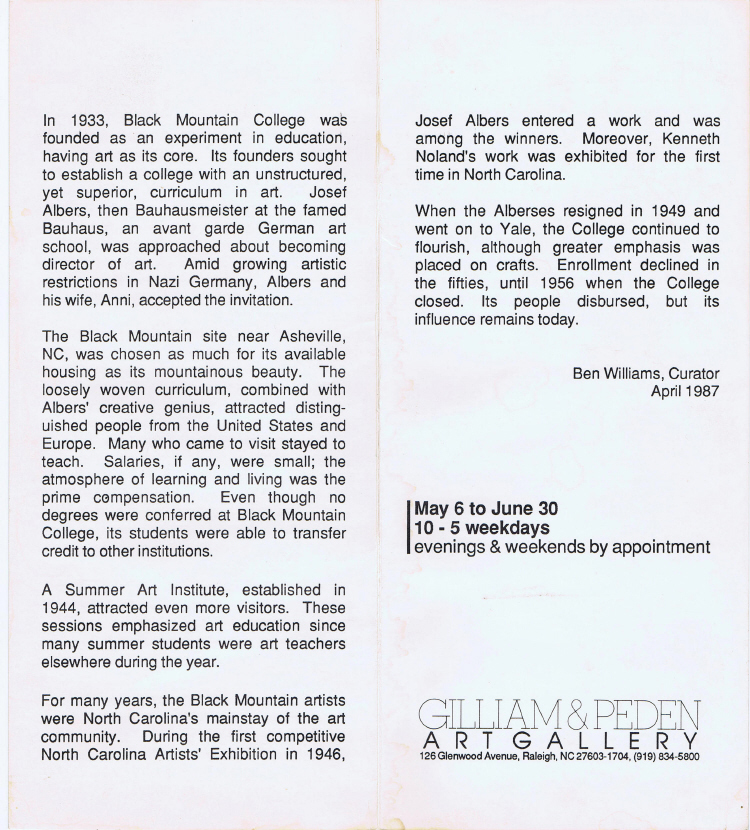
Raleigh has some small claims to fame relative to Black Mountain lore. Long before Glenwood South became known as an art center, Gilliam & Peden Art Gallery on Glenwood Avenue organized a show, curated by Ben Williams, called Black Mountain Connection. It featured Josef and Anni Albers, John Cage, Willem de Kooning, Franz Kline, Robert Motherwell, Kenneth Noland, and Robert Rauschenberg, as well as many others as seen below. This is my copy of the prospectus for the 1987 show.
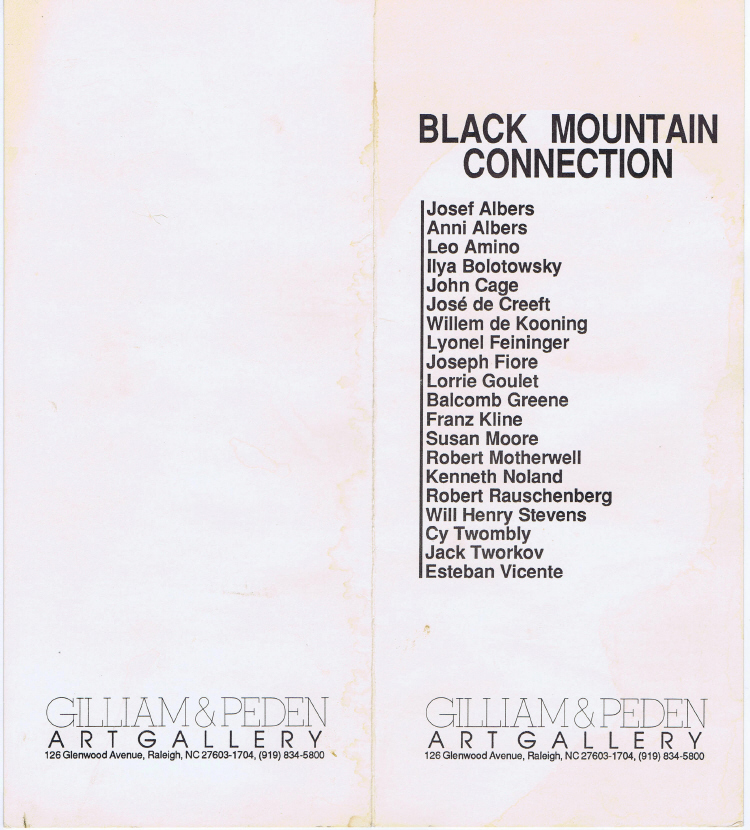
(click to enlarge)
The NC Museum of Art hosted a major exhibition of BMC material in 1987. In conjunction with this show, which also traveled to Annandale-on-Hudson and New York City, New York, , MIT Press published a truly sumptuous volume entitled The Arts at Black Mountain College by Mary Emma Harris. The book is wonderful, but I’m pretty sure it doesn’t now come now with the checklist of the exhibition which is tucked inside my copy from the show. Looking over it, I recall the intense immediacy evoked by the multitude of so many different kinds of objects in that show. There were architectural models, prints, oils and products of every imaginable drawing device and surface; announcements, bulletins, programs, photographs, glyphs, scores, weavings, calligraphy, letterpress printings and bound books. You got a sense of the interspersing and practical (yet clearly micro-utopian) productivity of this self-contained culture studying culture. The exhibition, The Arts at Black Mountain College 1933-1957 was organized by the Edith C. Blum Art Institute of Bard College and contained 219 items.
NCSU’s Gregg Museum has also done its part for BMC. Anni Albers was featured in a 2007 lecture (links to pdf) by Mary Emma Harris (who had previously lectured there about the architecture of Black Mountain). The NCSU Colleges of Textile and Design offers specialized degrees combining design and technology through the Anni Albers Scholars Program, which “is named for a designer who exemplifies the ideals and goals to which the program aspires: textile designer and artist Anni Albers.”
**************
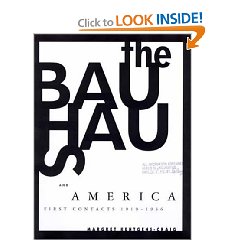
- Margret Kentgens-Craig’s book
Yet another local connection to the threads of BMC influence is Margret Kentgens-Craig, part-time Raleigh resident (and fondly remembered stalwart supporter of my Paper Plant bookstore), whose book The Bauhaus and America: First Contacts 1919-1936 delineates the major connections between the Bauhaus and Black Mountain College. Walter Gropius, a nine year director of the Bauhaus, lectured at the college, but also “tried continually to secure a teaching position at Harvard for Josef Albers.” Lucky for BMC he didn’t! Albers, according to Kentgens-Craig, “was the first Bauhaus master to acquire a position at an American educational institution, Black Mountain College. His wife Anni, who was Jewish, joined him.” The book describes the enormous impact Bauhaus ideas had on American architecture, and credits Lawrence Kocher, a BMC instructor, with creating opportunities for the dissemination of those ideas.
*************
A final BMC note: Jeff Davis posted recently at his blog Natures previewing the Charles Olson Centenary Conference, taking place at Simon Fraser University in Briitish Columbia June 4-10, 2010. Jeff will be in Vancouver “to make a presentation on Olson’s curricular projects.”
*************
MUSA – “making” in the US today
![[Matt's+bird+wall+in+evening_1_1.jpg]](https://raleighrambles.com/wp-content/uploads/2009/10/e969b-matt27sbirdwallinevening_1_1.jpg?w=407&h=325)
- Matt’s bird installation at entrance to MUSA show
![[Matt's+bird+wall+in+evening_1_1.jpg]](https://raleighrambles.com/wp-content/uploads/2009/10/e969b-matt27sbirdwallinevening_1_1.jpg)
The MUSA show at Cozart’s Antiques in west downtown Raleigh (just closed October 18th) was varied, intriguing and successful in presenting artistic takes on the issues behind the show’s concept – work and making things in the post-industrial age. The show was held in a back space which formerly housed a furniture factory. I have formerly described my personal connections to the space and its employees. I went opening night and then back for more pictures. There were a scattering of very interesting installations within this large show, and these were what I focused on.
![[hats_1_1.jpg]](https://raleighrambles.com/wp-content/uploads/2009/10/65c09-hats_1_1.jpg)
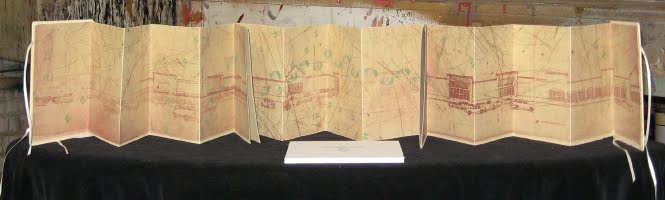
One striking installation had some very cool craft history associated with it. Jon Barlow Hudson’s “Felt Hat Body” also offered a chapbook called “The Handmade Felt Hat.” I picked one up and found it, as a papermaker, a wonderful history of the craft and the culture surrounding it. There was also a beautiful accordion book by Kathleen Loeven on display, seen below.
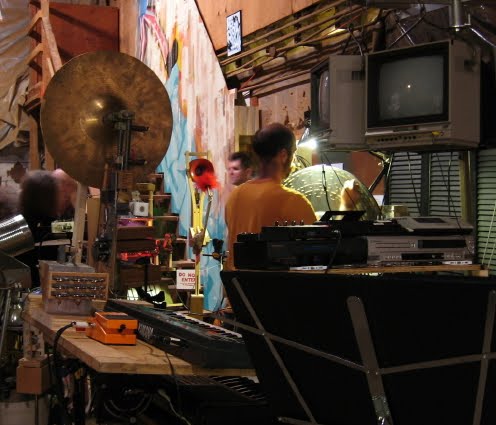
The show was incorporated into its space in a unique way. Many trappings of the former furniture works were still in place – from commercial tin decoration samples to the old paint shop. One of the installations used spray paint and objects to evoke the history of the place’s paints. The large back room featured a working silk screen process as well as the installation of “Invisible,” the music group that played at the opening and other project events. Below, an Invisible member sets the pegs on the player piano wheel that provided some of the random sounds.
The artwork was extremely variable in style and quality. My favorite piece by far was a large contraption that hung clay “icicles” over a pan of water. As visitors pushed the lever that lowered them into the water, the blobs of clay were soaked and softened. Gradually they would slip off their strings and fall into the water creating an evolving pattern in the water. Below is a picture I snapped just after a young woman had been splashed by a sudden plop.
![[splashed+by+the+piece!_1_1.jpg]](https://raleighrambles.com/wp-content/uploads/2009/10/87fe6-splashedbythepiece_1_1.jpg)
Another very fun piece was the shrine to highway US 1 by Dave Alsobrooks that was installed in a small side room. There was a church pew, a slide show of the artist’s road trip (whose imagery was “desaturated” for effect), and -best of all- a US1 bumper sticker which I have proudly displayed on my car! I liked the artist’s attempt to “find beauty in the mundane” and really like his description of the piece recording “the constant plodding of our human race towards an unknown future…”
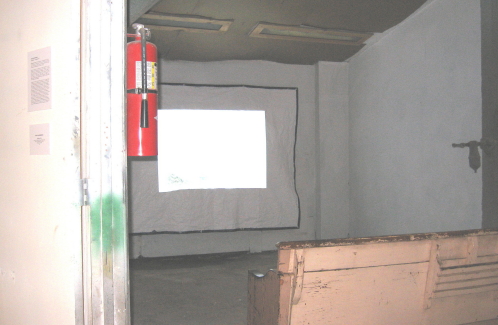
Highway US 1 shrine
The show was a lot of fun and thought-provoking as well. The gritty, down-n-dirty atmosphere provided an excellent setting for much of the art work. Carter Hubbard and Sarah Botwick are to be commended for finding a way to enlarge the possibilities for art events in downtown Raleigh.
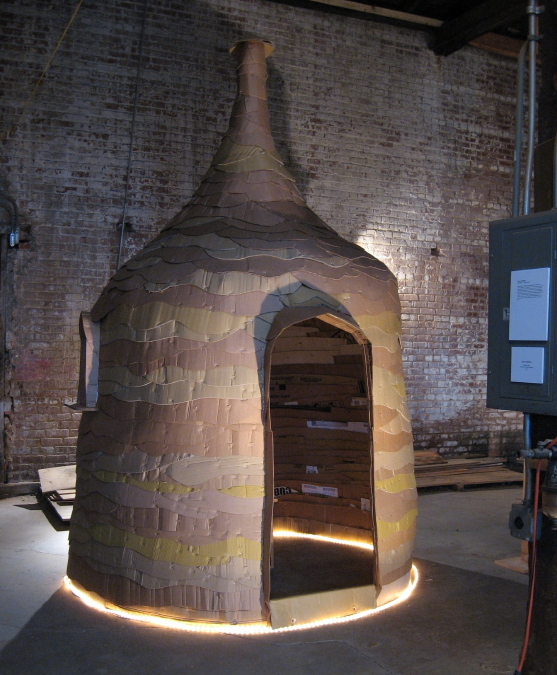
art house at the MUSA show
Black Mountain College Conference
The greatest thing a human soul ever does in this world is to see something and tell what it saw plainly. John Ruskin
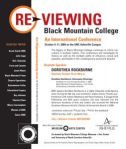
The conference held in Asheville October 9-11 about Black Mountain College and its legacy was a stunning success. A myriad of diverse presenters joined with performers, poets and artists to celebrate the influence of the college and the accomplishments of its alumni, both teachers and students. A collaboration of The Black Mountain College Museum + Art Center and UNC-Asheville, the conference was a long-awaited gathering of energies from across the country and beyond, searching for the memory and meaning of Black Mountain College.
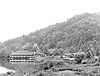
BMC existed just 24 years, from 1933 to 1957, but this conference made clear that its radical vision of education and incredible nexus of creative individuals resonates deeply in our arts and culture. There were so many threads of research and inquiry presented, I can only speak of my own journey through the presentations. Planning to focus on Ray Johnson, I found myself captured by powerful ideas about the basic philosophy and significance of BMC, and intrigued by new perspectives on the creative processes which emerged there.
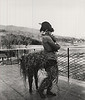
Initially, students at BMC were required to take only 2 courses: philosophy from John Andrew Rice and art from Josef Albers. Rice’s philosophy, informed by John Dewey, created a new mode of education at BMC, one that featured the internal discipline generated by students doing as much as absorbing. Michael Kelly’s presentation on Dewey in relation to BMC brought out the powerfully humanistic nature of liberal arts education as conducted at BMC. With art central to his view of experience, Rice designed the curriculum to elevate the quality of experience in students until they were prepared to be democratic citizens. Seymour Simmons helped connect the educational philosophy to the artistic act with this wonderful description of the act: “an inventive response to genuine problems involving collaboration and conflict while engaging and integrating multiple human capacities.” Josef Albers wanted for his students no more or less than a new mode of seeing, and his manifest genius was the nugget of magnetism that drew such stellar powers to the place.
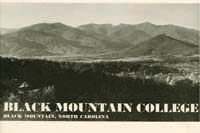
The place! Over and over the theme of place ran through the conference. Black Mountain was a unique haven of sorts, and a bivouac as well for the sorties against New Criticism and the strictures of Modernism. It was literally a quiet spot in the harried life of urban artists and teachers who came. Yet there were privations, great stress, and no assurance of the fame and influence we look back on today. Two living Black Mountain figures, Dorothea Rockburne and Michael Rumaker, presented at the conference and helped establish the sense of the place.

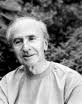
I found the presence of two deceased BMC figures, M.C. Richards and Ray Johnson, to be very strong due to the passionate work being done on them by current young scholars. M.C. Richards embodied the highest principles of the Dewey aesthetic in seeing and living the connnection between art and life. Jenni Sorkin of Yale University described Richard’s costly rejection of a conventional academic career for the esoteric but rewarding concepts of Rudolph Steiner and Matthew Fox, the “Centering” of being required for art in clay,and the attempt to practice the apprenticeships of art to prepare for “the big art… our life.” Kate Dempsey and Sebastian Matthews both offered invigorating interpretive perspectives on Ray Johnson, and convinced me once and for all that Ray is the epitome of Black Mountain students, and carried into the world a fundamental store of post-modern concepts gained at Black Mountain.
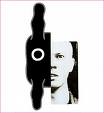
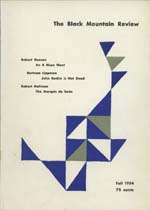
More than one speaker described the roots of post-modern thought to be discerned in the Black Mountain canon. Andrea Lui from NYC named three: 1) knowledge as contingent and partial, 2) photography as art, and 3) promiscious mixing of disciplines. The relation between and hierarchy of the disciplines at BMC provided some interesting contention among the scholars. Speaking of the interdisciplinary approach, Louly Peacock Konz offered perhaps the most purely entertaining talk of all with her description of the play “The Ruse of Medusa,” translated from Satie’s French by M.C. Richards, and performed by Buckminster Fuller as the baron and Merce Cunningham as the “costly mechanical monkey,” among others. Black Mountain College established a perceived “school” of poetry, encompassing authors who never set foot on the campus. Rachel Stella from Paris described the Black Mountain Review as the base for a “textual community” which helped transform the structure of literary publishing of the era. Charles Olson’s massive literary influence came up again and again, with Jonas Williams of SUNY-Albany reminding us that Olson said: “art does not describe, but enacts.” Forming, transforming, teaching by action, seeking the transcendent in the material: these were the forces that coursed through education at Black Mountain. Over several near-future posts, I will recount some of the amazing insights shared at this conference, especially my greatly enlarged perspective on Ray J. The central role of experience in learning and the intellectual freedom derived from Socratic and democratic principles were key elements in Black Mountain’s existence and lasting influence. From this cauldron of intellectual striving and artistic practice emerged various and wonderful creative expressions with much to tell us today. This conference did not dissect a historical movement, but uncovered living roots of a vital cultural force that sends wick green shoots upward as we speak.
We must carry in our souls a picture of creating little by little
the vessel of our humanity. M.C. Richards
MUSA exhibit opens, taintradio features, Raleigh’s post-industrial art scene cooks
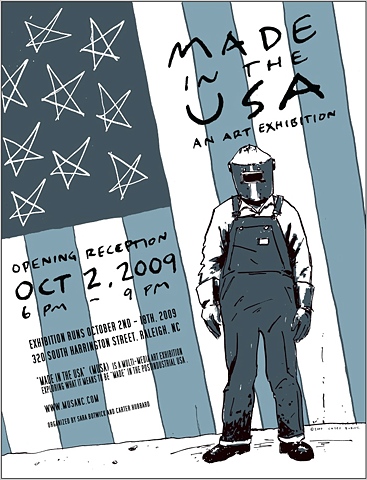
MUSA is a “post-industrial art exhibit” whose content will relate more or less directly to the venue: a dormant furniture factory across from Humble Pie in downtown Raleigh. An art show in this space really resonates for me, because I have such fond memories of the crucial employment and quirky stories that arose from my artist friends’ work there in the 1980s. The owners made annual trips to Asia for antiques and prints, but the majority of the stock was furniture that was “aged” – whipped with chains and other abuse, or modified otherwise – before wholesaling to Neiman Marcus. Bill and Otho were enlightened and tolerant employers to several good friends, and I’ve always appreciated it.
Now Otho is offering the space, which ceased business in 2002, to Carter Hubbard and Sarah Botwick, two art entrepreneurs who hope
I mentioned this show in July and bemoaned the Flash software used to present the website, which actually looks quite nice, but presents minor navigation issues and major Google search issues, because all of the info appears to be insulated from the web-crawlers. Now the site has a large amount of info and lots of artwork examples, most of which present some kind of connection to industrial themes. The work is also integrated into the factory space, including one series that explores the history of the paint in the room in which it is situated. The dying pastime of pigeon-keeping, the dying art of hat-making, Latino work portraits, and the use of trees all form a part of a broad set of responses to technological change and its implications for work.
Location: 320 South Harrington Street, Raleigh, NC
Web Address: www.musanc.com
Opening Reception: “First Friday”, October 2, 2009 6-9pm
Reg. Hours: Monday – Thursday, 11-5, Friday, Saturday, Sunday, 1-7pm
“Invisible Sounds” – site-specific live music prior to the screening of “With These Hands” Q&A to follow, Oct. 10, 6pm
Exhibition Dates: October 2-18, 2009
*************
taintradio, poised to survive the “post music industry age,” sends word it will present another feature at Marsh Woodwinds. The internet radio venture has added several new shows to its weekly cycle, including Philadelphia-based Jeff Duperon’s Congo Square. Feature info below.
taintradio.org & Marsh Woodwinds presents guitarist/composer Eugene Chadbourne concert & live webcast on October 3rd.Avant-garde multi-instrumentalist and composer Eugene Chadbourne brings his unique anarchic blend of jazz, punk, country, improv and noise to Marsh Woodwinds, 707 N. Person Street in Raleigh, NC on Saturday, October 3rd at 8pm. The concert is a presentation of the taintradio/Marsh Woodwinds concert series, and will be broadcast live on the Web to listeners worldwide at www.taintradio.org. Tickets are $10 at the door, and free refreshments will be served.It’s been nearly 5 years since the Greensboro-based Chadbourne has performed in Raleigh, and we are delighted to add this date to his fall touring schedule, which includes Berlin, Vienna and Istanbul.Chadbourne has been a major presence in improv, punk and jazz circles for over 30 years, including work with John Zorn, Charlie Haden, The Violent Femmes, Billy Bragg, Tony Trischka, The Red Clay Ramblers, Marc Ribot, Jimmy Carl Black and many others. Relentlessly eclectic and experimental, Chadbourne writes and plays a wide range of music, from free jazz interpretations of classic honky-tonk country to transcriptions of Bach for banjo and his infamous invention, the electric rake. Chadbourne’s dozens of solo and collaborative albums add up to one of the most consistently challenging and rewarding bodies of work you’ll find in experimental music.This is a rare chance to hear this musical legend in an intimate venue on Saturday, October 3rd.************

SparkCon expanded and upgraded its arts event this year, taking over Fayetteville Street with 13 different “…sparks” at 24 venues, intensely focused on the 1st two blocks of Fayetteville. From Raleigh’s emerging status as the East Coast’s gaming industry hub to the latest creation from uliveandyouburn, this street festival helps to brand Raleigh as a city of designers and 21st century entrepreneurs.
*************
And as a final note, we head toward the “post newspaper industry age” in the company of Raleigh Public Record, whose detailed candidate profiles and “Sunshine” public record posts are demonstrating the validity and value of Charles Pardo’s vision of 21st century journalism.
My nature column at RPR will return as soon as some of my excess pies get cooked!
Grimanesa Amoros centerpieces strong Artspace retrospective

Griminesa Amoros’s dramatic torsos dominate the Gallery One show at Artspace, but are surrounded by equally strong work as the artists -in-residence retrospective show moves toward its closing September 5th. Artspace has used this series of residencies to raise the bar for out-of-town alternative visual artists’ showings in Raleigh, and has highlighted several highly deserving local talents as well.
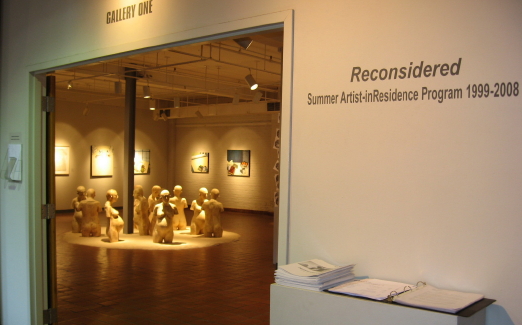
Reconsidered brings together myriad artistic styles unified by a passionate and meticulous attention to physicality – to the actual visual textures presented by the artistic artifact. The mental constructs that inform these explorations each seem amazingly different – the show itself is quite a collage.
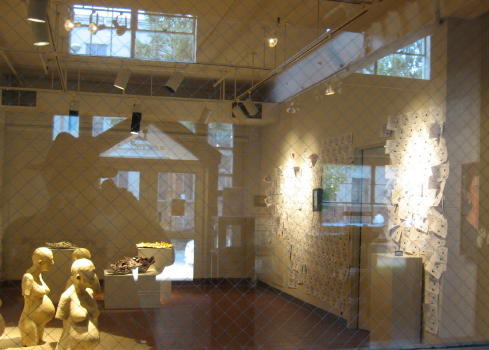
The media installation by Sherri Lynn Wood, seen on the right wall above, was interactive in a way that emblemized the reach this program had into the community. Spectators were invited to use small printed forms to share their own slogan in response to the video, which featured repetitive phrases. The responses slowly filled the wall around the video screen throughout the show. You can see the video yourself at www.mantratrailer.com.
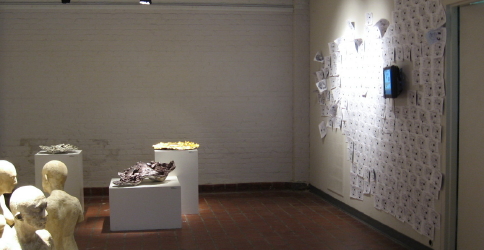
Eileen Doktorski’s bronze landfill castings are in the center rear above. The use of precious metals to cast the surfaces of human waste gave the pieces a strong aura of future artifact – ironic snapshots of our throw-away culture.
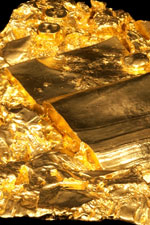
Eileen Doktorski
The show includes a range of more traditional work. Anthony Ulinski’s muted oil paintings seem nearly empty at first glance. Rarely is such really really low-key subject matter treated so thoughtfully. The strokes and composition radiate the sensibility of this master woodworker and excellent soul. IlaSahai Prouty’s traditional felts present as shields or medallions, though she calls them sails on the ocean of words, which I also like very much. I didn’t see her 3-D shapes as wind-pushed but as macroscopic waves of the incredible textures that permeated the show. Ann Marie Kennedy presents pristine handmade papers with exquisite suspensions of plant materials. Laura Berman opens the show’s entrance with yet another textural study – the cumulative effect of a huge spread of deceptively un-simple line drawings on paper swatches, carefully applied as a wall installation. Carrie Scanga’s etchings are accurately described in the show catalog as “enigmatic and uncanny…concerned with…the liminal aspects of memory.” My favorite print, “baker banana,” evoked Picasso’s harlequins .
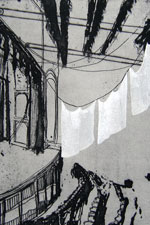
Carrie Scanga
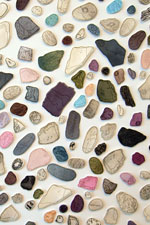
Laura Berman
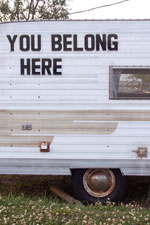
Sherri Lynn Wood
*********
The pregnant figures with truncated limbs take some digesting, to say the least. The astounding visceral physicality of the body casts combines with the amorphous identity of the figures, both personally and sexually, to create a large silence with many voices, muted and stoic, and filled with tension. All of their bodies are identical and pregnant; each head is a different human, at least to my eye. There are male and female pairs, clearly coupled but arranged in various states of estrangement and bond. A lone female figure emanates calm and seems a narrator, or Grimanesa herself, contemplating the profound enigma that dawns on the spectator as one studies the figures and reflects on the title, which is You Cannot Feel It…I Wish You Could. If you haven’t kept up with the emergence of the male pregnancy concept, this piece is perhaps the perfect introduction. Grimanesa has blessed Raleigh with another vision from her far-reaching explorations of human identity and artistic media to reflect it.
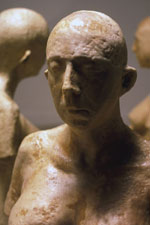
Grimanesa Amoros
Artspace has done an outstanding job with this series. The artists each had the rather unique opportunity to develop an installation or body of work totally integrated into a large exhibit space they control. Teaching at Artspace each summer I have seen them work, share with summer students and the public, and find a balance between sharing their semi-public work process and creating the time and space to produce sophisticated and enriching art right before our eyes. Part of the series’ great success surely lies with Lia Newman, who serves as director of programs and exhibits with great devotion and skill, but also brings the perspective of an active and successful artist who can really make these visitors feel at home and understood. Yeah, Lia!!
raleighrambles.com
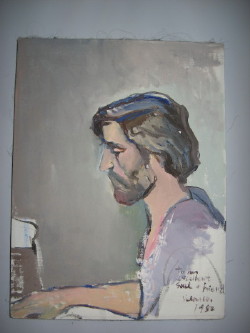
portrait by Guillermo Velasco


 Raleigh Rambles


