Bain Project Holds Forth Downtown
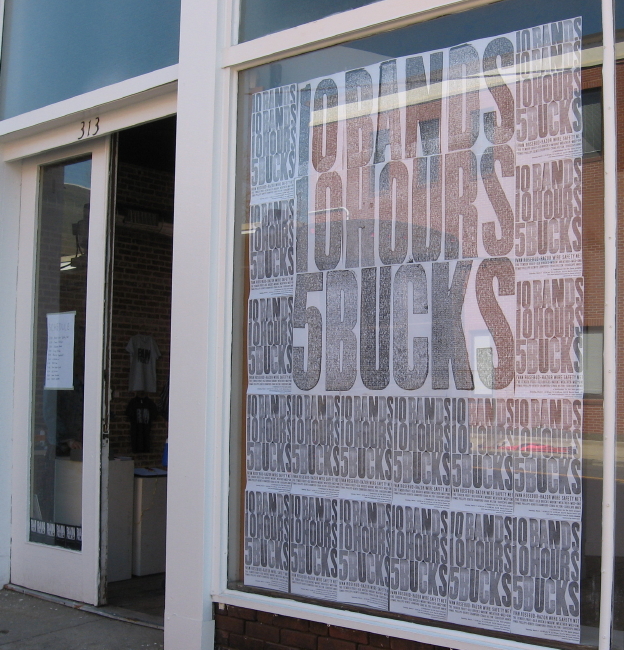
The Bain Project artists and supporters put together a huge bash on Martin Street and raised awareness of and funds for this fascinating and rapidly developing project. Ten artists, joined by three documenters, are transforming an abandoned historic Art Decco structure on South Wilmington, and making some great individual art along the way. Many of the individual responses were on display Saturday at 313 West Martin Street, a space provided by Clearscapes. The transformation of the 1940 water treatment plant will be on display the middle two weekends in May.
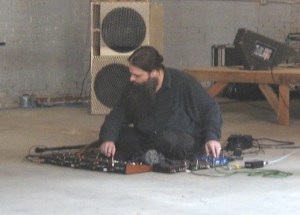
subscape annex
The big draw this weekend was the marathon music session, helpfully bannered at New Raleigh, which eventually drew a large evening crowd. The early afternoon acts were experimental and sparsely attended, but a truly amazing event took place at 4 PM. Benito Crawford, on the left below, devised and conducted a performance where the audience participated through a net interface. Crawford is a doctoral student in music at Duke, and the piece performed Saturday is part of his dissertation.
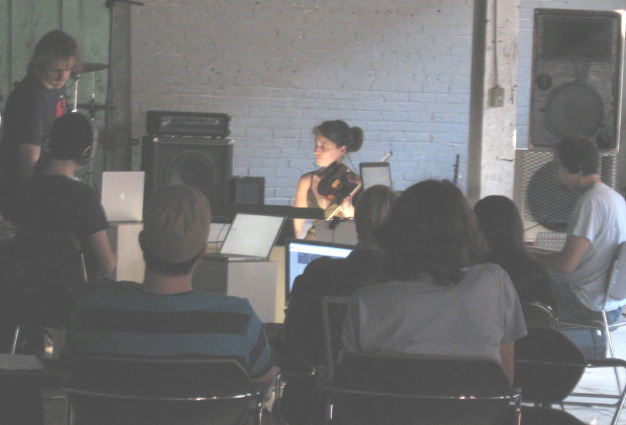
It was fantastic watching numerous people in the crowd getting their laptops ready, logging on to the website, and then offering their input into the outputs of the musicians and the synthesizers.
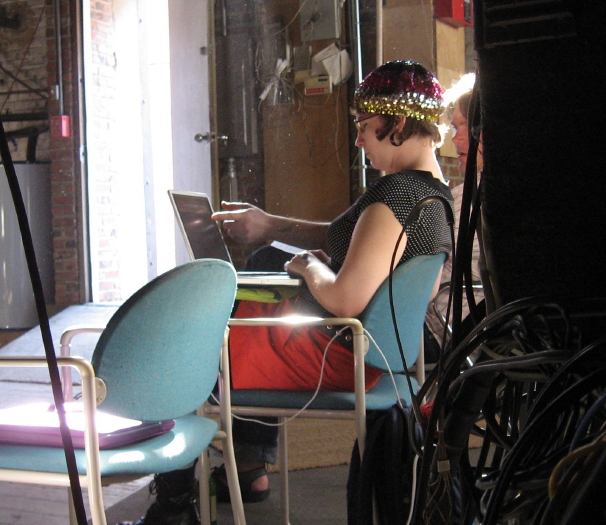
Bain artist Stacey Kirby readies her PC
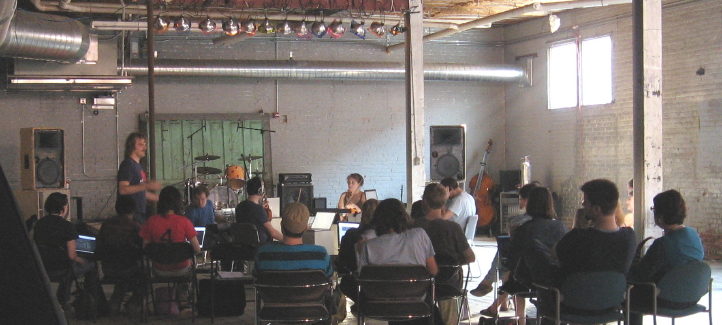
musicians and audience collaborate
The evening music drew much larger crowds, but being generationally impaired, I spent most of my evening visit out in the front room with the Bain artists, who were rotating duties at the door, selling t-shirts and networking. There were small heavily layered iconic pieces from Marty Baird and Lee Moore, traditional oils from project leader Daniel Kelly, reflective collages on graph paper from Sarah Powers, a photo montage from Lia Newman, a piece of mail art from Stacey Kirby, and much more.
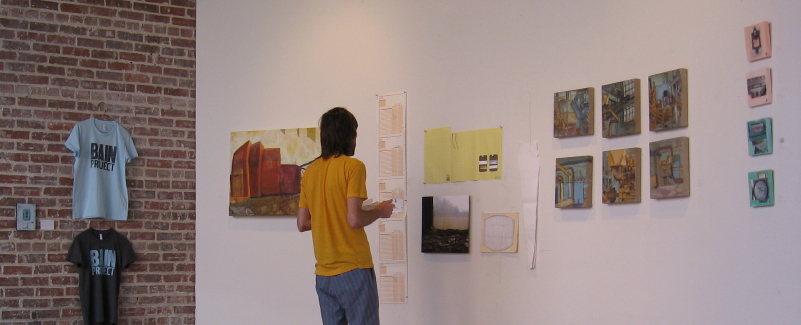
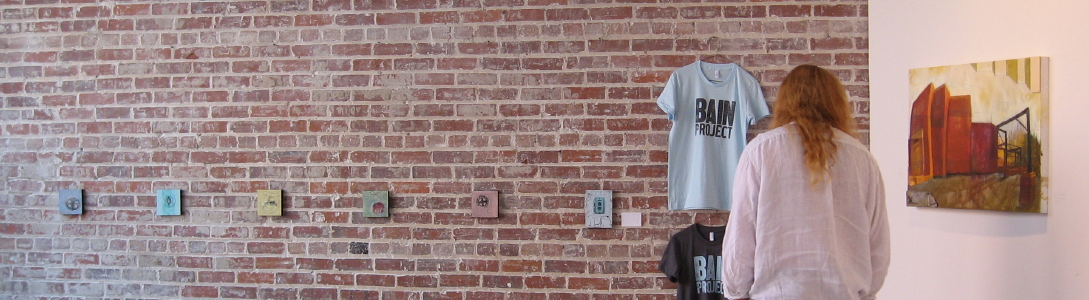
This project has picked up critical mass and velocity, and that was made clear on Saturday. Lots of energy, lots of fascinating work, and now a ground-breaking presentation of music in downtown. Go Bain!!
A Zane Game-Changing View of the Future
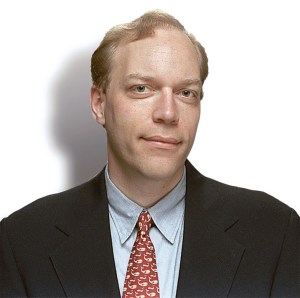
Jon Peder Zane is one of numerous dedicated, serious folks who are working to keep good reporting and good writing alive at the News and Observer. He was the book editor until the drastic changes under McClatchy’s management turned him into the Ideas Reporter, and I have actually very much enjoyed the products of his new beat. He has written about everything from banned Christmas trees to bioethics. He has also consented to create a series of videos for NandO’s website – Fist Bumping is typical. ( He really turns being stiff into a comic artform). But this guy’s writing is just downright stimulating! His book, The Top Ten: Writers Pick Their Favorite Books, has gotten a great, well-deserved response, and his 1999 Distinguished Writing Award proves he has been doing great work before and through all the changes at NandO.
J Peder Zane: Science visions, dark and bright
He has outdone himself, in my mind, with his response, this year and several previous years, to the Edge annual big question. These highly provocative writings cast a huge net in searching for the meaning of our times. In the essay linked above, he sees hope in the prospect of vastly improved bodies, and justified fear in the idea of transmitted neural signals. He ends with the hope that science will continue to be of overall benefit, as in the past. Zane focuses on issues about which he has written before – stem cells and genomics. But he gave a sense of the wide ranging ideas contained in the series, and I went and downloaded and printed them. I will be processing what I read for a long time, but I will offer the notes below, with thanks to Jon Peder Zane for the motivation and stimulus!
***************
Edge World Question Center 2009
What will change everything?
I love SF, and these essays skirted SF with regularity, while offering very real solutions for some pretty big problems – like death, endless energy, and radical transparency in the marketplace. The most sinister visions by far concern our growing ability to monitor and “tinker with” the mental experiences generated by the brain. Helen Fisher, an anthropologist from Rutgers, thinks Vance Packard’s “Hidden Persuaders” will take chemical and totally effective form. But we alter our consciousness with drugs and media all the time, and I think we’re more resilient than that.
The most practical visions derived from nanotechnology, with the idea that developing molecular, self-directing machinery would make materials goods as “free” as information is already fast becoming. An intermediate step in this process is suggested by both Chris Andersen and David G Myers: universal computers and all that implies.
The truly revolutionary nature of information technology is overshadowed by hyperbole about it. Kevin Kelly of “Wired” envisions a conscious intelligence arising from the Web – a “ubiquitous AI embedded in the feedback loops” of cyber civilization. Kevin Sloan, a “digital technologist,” predicts the accretion of a universal memory. As I read through the numerous essays that predicted the reality of artifical intelligence, I was always disappointed by the clear fallacies in the various positions, and comforted by the divining rod of clarity I received so many years ago from Coleridge. Clarity, that is, as to the certain uncertainty in defining the creative element that informs and energizes the human mind. They can map every darn neuron and correlate every one with a function, but that still won’t give them what they need to build a true thinking machine. Coleridge described it as a balance of “Fancy” and Reason – later Chomsky used the very methods of rational science to prove the uncatchable infinity that is human expression. Art represents a conscious presentation of creative forces that inform every aspect of human culture. That element will always be missing from artificial intelligence. Not that it’s missing from true science – which is the making of new knowledge. Timothy Taylor, an archeologist, points out the creativity generated in the “tension… between fixity and change” – science, in his view, being the major source of change. Science gives us our material culture, art attempts to re-present and name the meaning of that culture. The latter, for Taylor, is attempting fixity, but I think that’s true only for the linguistic scientist, not the poet and artist. Good art gropes to name and describe the changes, and thus makes in actuality a “new thing.”
The basic point is made by several writers in the series. Celebrating our “new” awareness of rationality’s limits, Randolph Nesse from the University of Michigan sees good science “recognizing that the body is not a machine.” Stuart Kaufman, a proponent of the value of “biocomplexity,” simply states: “the universe is open, neither fully lawful nor random.” Every artist, aware or not, assumes a non-linear infinitude of possibilities in order to work. These essays have taught me that scientist working in many fields have so much reason to feel the same. Closing with the words of Mr Nesse: “Some evolved systems may be indescribably complex.” For me, a comforting thought.
***********
Postscript
From the future to the past, J Peder Zane just wrote a couple of pieces for NandO that take a hard look at Southern culture. First he really stuck his Yankee neck out with a call for destruction of the Confederate memorial on Capitol Square. Several people were really ready to chop down on that neck! Today’s Sunday edition brings a look at Southern comic caricatures and what they say about the South. Keep up the good work, Mr. Zane! We natives need all the intellectual prodding we can get!
Cara Goes to Honduras on a Heifer Adventure

Cara Mia, my dear heart indeed, (though named that by her father for the song), had what we knew in advance would be a life-changing experience when she traveled to Honduras this past summer. The trip was sponsored by World View in Chapel Hill in coordination with The Heifer Foundation, whose work Cara has supported for years.
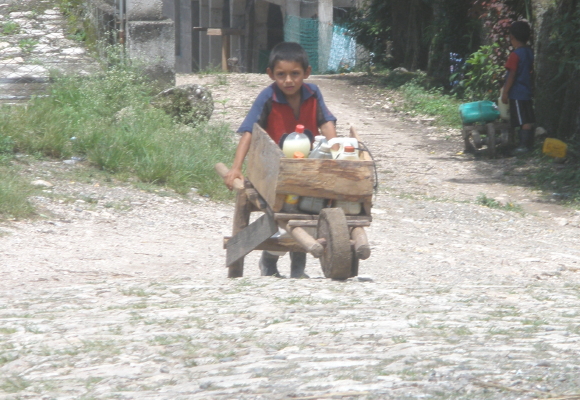
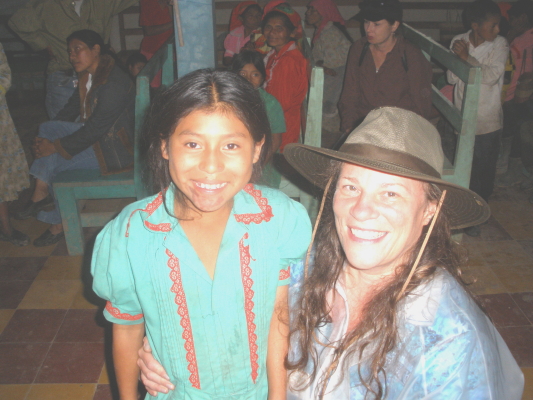

She saw many wonderful sights as a tourist and had many uplifting experiences as a goodwill ambassador, but she also came back from the trip with a keen sense of a very different side of the global economy, a new perspective on the rich material culture we enjoy, and a strong practical understanding of how sustainable agriculture, gender equity, and humane microfinancing can bring new life to struggling Third World communities. Best of all, she met some endearing Honduran people who welcomed visitors, shared their celebrations of success with new agricultural endeavors, and showed themselves willing and able to respond to the Heifer philosophy and to “pass on the gift” many times over in response to the support they had received.

I was most interested in the farming and infrastructure. Above is part of a system being developed for composting manure to produce methane at a farm school sponsored by Heifer. The gas is then piped directly to a cookstove. Rainbarrels and cisterns were a common sight, as it was the rainy season, though clean water was a scarce commodity. Communities sometimes shared major equipment like a corn grinder.

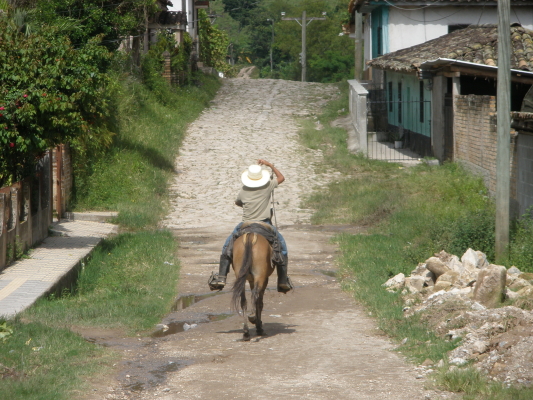
Cara started with a countryside bus trip made necessary by a change in plans after the international airport in Tegucigalpa closed due to a jetliner disaster caused partly by short runways. After orientation in a this large capital city, she traveled to mountain communities of indigenous Lenca and then on to Mayan ruins, as well as the Chorti Maya who are the builders’ descendants, before returning home. So she saw a wide range of economic levels of existence.


The agricultural scenes just seem to radiate more hope. As a teacher, Cara was left with many enduring images of children whose chances of healthy survival and education had been improved by the efforts of their parents, with the help of Heifer. Below are boys at an orphanage near Tegucigalpa with Heifer Foundation cows.

This is just a smattering of the images and lessons from Cara’s trip. The slide show I selected is also just a fraction of the images she brought back, though you will see some beautiful landscapes and ancient Mayan architecture. She presented at the NCAIS teacher’s conference in November and has had several other opportunities to share what she learned. I look forward to seeing her continued response to the experience.
The Bain Water Project – Post 1

One of the most exciting prospects of the coming year for me is following and responding to The Bain Water Project. The E.B. Bain Water Treatment plant is a designated Raleigh Historic Landmark, though it has been neglected for many years. Now a new art project is developing dialogues about the structure and its place in Raleigh’s culture as a new development of the property is planned.
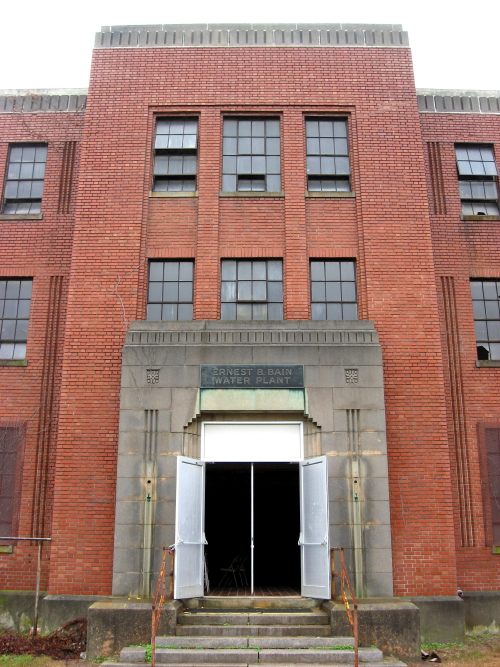
The top picture is filter rocks made of unpolished porcelain that were used to filter the water at Bain. Above is the entrance to this art deco masterpiece. Raleigh’s website states:
While strictly utilitarian in concept, the Bain plant, as built, is perhaps the foremost Art Deco style building in Raleigh.
The Bain facility is in a terrible state of debris-filled shambles in the areas used for storage in the 1990’s. But the industrial plant itself is like a museum. I had a chance to visit the site when I presented to the project artists about Walnut Creek and the watersheds associated with the plant and Raleigh water history.
The artists are a wonderful mix of highly qualified individuals who work across a wide spectrum of media. At the Boylan Artswalk, they displayed some wonderful preliminary work, including prints, paintings, and photographs. It will be fun to follow this project and I have designated a permanent page about it on Raleigh Rambles. Check back for more!
First Friday recap – downtown Raleigh teems with good art.
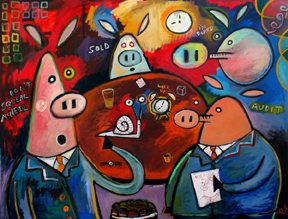
Don't Squeal McNeil by Keith Norval
Up to date news is not the style of this blog – I am, as Clyde reminds me, part of the Slow Blogging movement. No matter for this post – EVERY Friday is First Friday this December til Christmas, and you may easily recreate my journey with most of the galleries discussed.
Starting at Artspace as usual, I stopped by the front gallery to see Keith Norval’s opening of The Corporate Art Show. Keith has outdone himself in the wake of his new parenthood, along with the talented Ann Podris. Keith’s quirky rendering of goofy cartoon images with surprisingly subtle oil color and brushwork may or may not be your favorite style, but you can’t miss these hilarious concoctions of Angry Squirrel Customer Service, Rhino Dollar Bills, and Pig Salt.
This new series of oil paintings by Keith Norval explores the theme of business and animals. With the current state of things (environmental destruction, factory farming, extinctions) it seems animals would be better off if they had some kind of representation. …this show aims to give them their own voices. Artspace website
The blessed couple was upstairs in their gallery, dancing and swaying their little bundle into First Friday submission. Good luck, guys, and sleep when she does – you’ll need it!
*************
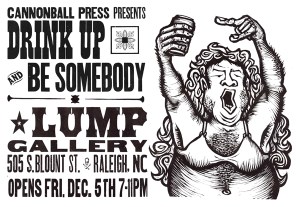
Down the street at Lump, more caricature and mayhem. Cannonball Press has a jam packed display, indeed “an irrefutable deluge of relief prints.” You could walk in here with a hundred bucks and get a lot of gift shopping done, if you have friends who like inyourface graphics.
************
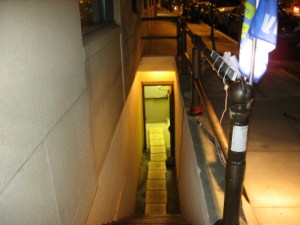
Up on Fayetteville Street, in what used to be my Dad’s barber’s basement shop, The Fish Market was showcasing an always widely varied and intriguing selection of work by College of Design students. Marie Formaro had some wonderful spires of canvas framed with metal, as well as a beautiful screen on canvas called “Ritual of Gesture.”
**************

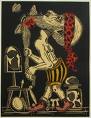
Right down Hargett and upstairs is a truly fine gallery in a decidedly unflattering space. Adam Cave Fine Art stands up well to its claim as a home for national level talent. The current offerings that reach that level are mostly prints, from the precise yet softly diffused light studies by Donald Furst to the highly textured assemblages of interacting shapes in the woodcuts of Merrill Shatzman. My favorites prints were the alphabet and symbol studies by John Gall; intaglios with a hint of Bosch and a good dash of Rube Goldberg.
*************
While Adam Cave looks and feels like the former shopkeepers’ living space it is, the funky semi-amateur galleries at the top of Glenwood are intricate mazes of hopeful artists, all offering wine and cookies and hoping to share their wares. The Carter Building at 20 Glenwood and Point of View at 22 have a rich mix of artists, most of whom appear to have day jobs. Make no mistake – there are magnificent high spots in these cramped halls – and lows as well. I was thrilled to find Ellen Gamble and her abstract oils again after several years. Peter Filene‘s double exposures (no photoshopping at Point of View!) present well composed and strongly evocative images. And I’m always happy to have my horizons broadened by strong work in a realm I wouldn’t usually investigate – such as the fashion line drawings of Stephanie Freese, whose retro blackline compositions evoke a blend of the roaring twenties and film noire – and she turns out to be a fascinating comic artist whose online publishing work, pictured below, is revered by writers.
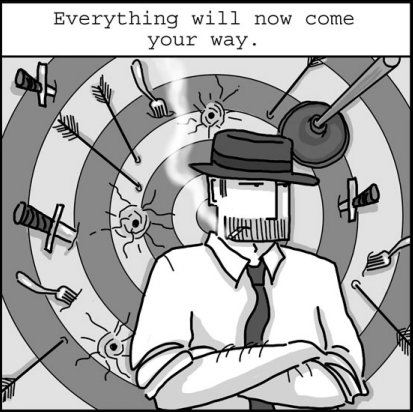
Dada Detective
***********
I make a late pass back east, heading for home but hoping to catch a couple of more spots. I have amazing luck. I finally catch up with Nancy Baker, whose Tire Shop Gallery started on McDowell, migrated to Glenwood, and has found a permanent home in the snazzy new building on Morgan across from the Flying Saucer. Her work, always at such a high technical level, captures scenes from Medici Florence to outer space with equal ease and insight.
They were ready to close shop at the Longview Center Gallery, which is curated by Rory Parnell from the Collecters Gallery. I asked the artist, Jesse Green, if I could see his light sculptures with the house lights out, and we had a neat experience looking at them in the dark. Then they scooted me out of this basement space where, believe it or not, my friends and I built a church coffeehouse in the late sixties.
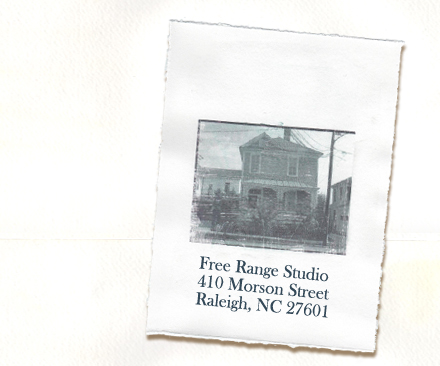
I was the last customer at Carrie Knowles’ Free Range Studio, which held it’s last First Friday event. Carrie will concentrate on studio work and continue to have several events each year. Heading home, I realized I had missed DesignBox. You really can’t do it all.
*************
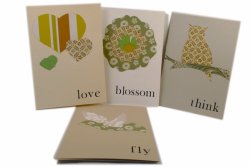
I took a break from finishing up this post to visit the Boylan Artswalk, where dozens of talented folks exhibit the first December Sunday each year. It was a chance to check on Rebus Works and their fine display of work from Penland, and to see a museum quality piece of cabinet work just completed by Billy Peacock down in the basement. BLAM! was exhibiting over at Lee Moore’s house, with previews of the Bain Water Project work. I will be posting much about the Bain Project soon. The Boylan neighborhood sported pet portraits by Emily Weinstein, linocuts and CDs from Gerry Dawson, pottery from Nancy Redman, coptic journals from Bryant Holsenbeck, and much, much more. Friday or Sunday, there’s a lot of creativity around this town!
raleighrambles.com
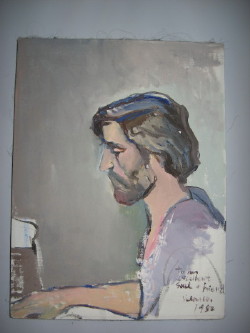
portrait by Guillermo Velasco


 Raleigh Rambles


